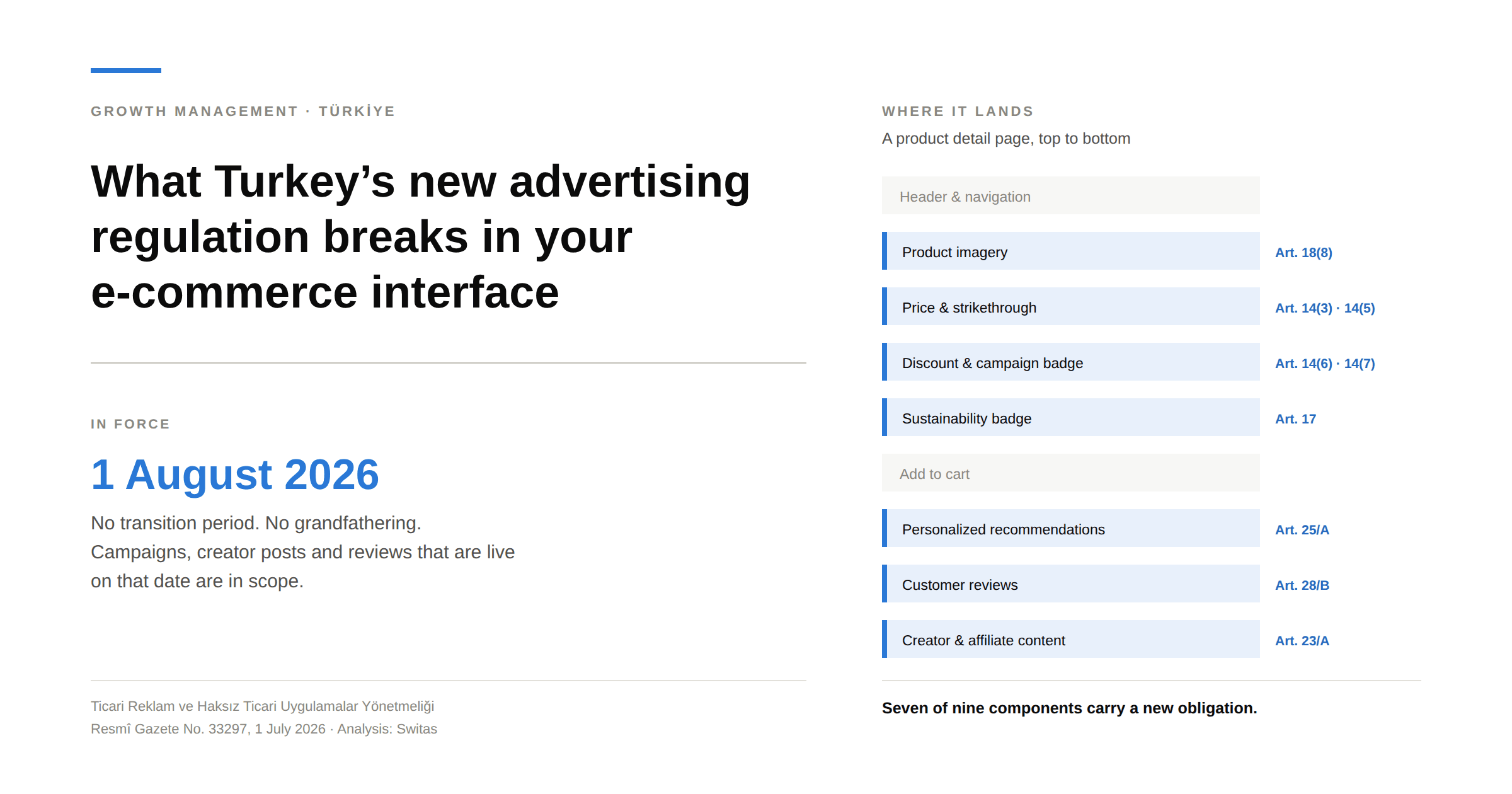
On July 1, 2026, Türkiye's Ministry of Trade published a sixteen-article amendment to the Regulation on Commercial Advertising and Unfair Commercial Practices (Ticari Reklam ve Haksız Ticari Uygulamalar Yönetmeliği) in Official Gazette No. 33297. It enters into force on August 1, 2026.
There is one commencement article, no staggered sub-clauses, and no transitional provision. No grandfathering for discount campaigns already running, no carve-out for influencer posts already published, no exemption for reviews already displayed on your product pages. The compliance runway was exactly one month.
Most of the coverage you will have read frames this as a legal update — a matter for your compliance team and your outside counsel. That framing is incomplete, and it is why so many teams will discover the problem late.
This regulation lands on your interface. It changes what your strikethrough price is allowed to say, which reviews may appear on your product detail page, what your personalization layer must be able to explain to the user, and what your campaign creative must disclose. Every one of those is a component someone on your product or growth team owns, and several of them are load-bearing for conversion. A legal memo will tell you the rule. It will not tell you which component to change, or what changing it costs you.
This article is the second half of that work: the amendments mapped to the interface elements they break, the audit sequence we would run, and an honest read on where compliance and conversion actually conflict.
Two notes on scope before we start. First, the regulation applies to commercial advertising and commercial practices directed at consumers in Türkiye — if you are an international brand selling into the Turkish market, you are in scope regardless of where your entity or your servers sit. Second, this is a product and growth analysis, not legal advice; we have flagged the points where the underlying text is genuinely arguable, and those are conversations for qualified Turkish counsel.
The eight changes that touch your product surface
| # | Amendment | Regulation article | Interface component affected | Conversion exposure |
|---|---|---|---|---|
| 1 | Discount reference price window cut to 10 days | Art. 14(3) (replaced) | Strikethrough price, discount badge, PDP price block | High |
| 2 | Each sales channel priced independently | Art. 14(5) (new) | Cross-channel pricing logic, app-vs-web parity | High |
| 3 | Conditional campaigns brought into the discount regime | Art. 14(7) (new) | "Buy 3 pay 2", free-shipping thresholds, gift-with-purchase | Medium |
| 4 | Reviews restricted to verified purchasers | Art. 28/B (rewritten) | Review widget, review collection flow, review count | High |
| 5 | Complaint platforms: response window cut to 48 hours | Art. 28/C (amended) | Escalation workflow (not an interface change) | Low |
| 6 | Targeted advertising must be explainable and adjustable | Art. 25/A (new) | Personalization layer, recommendation modules, preference centre | Medium |
| 7 | AI use disclosed; synthetic endorsement of real people banned | Art. 18(8) (new), Art. 27(12) (new) | Creative, chat interfaces, product imagery, virtual models | Medium |
| 8 | Influencer labelling rules moved into the Regulation | Art. 23/A (new) | Creator briefs, post templates, affiliate content | Medium |
Plus environmental claims (Art. 17), covered in section 9 — lower conversion exposure for most merchants, but a direct hit on sustainability badges and filters.
Below, each one in the form that matters: what changed, what breaks, and what to do about it.
1. Your strikethrough price now has a ten-day memory
What changed. Article 14(3) has been replaced, not merely edited, and the replacement does three things at once.
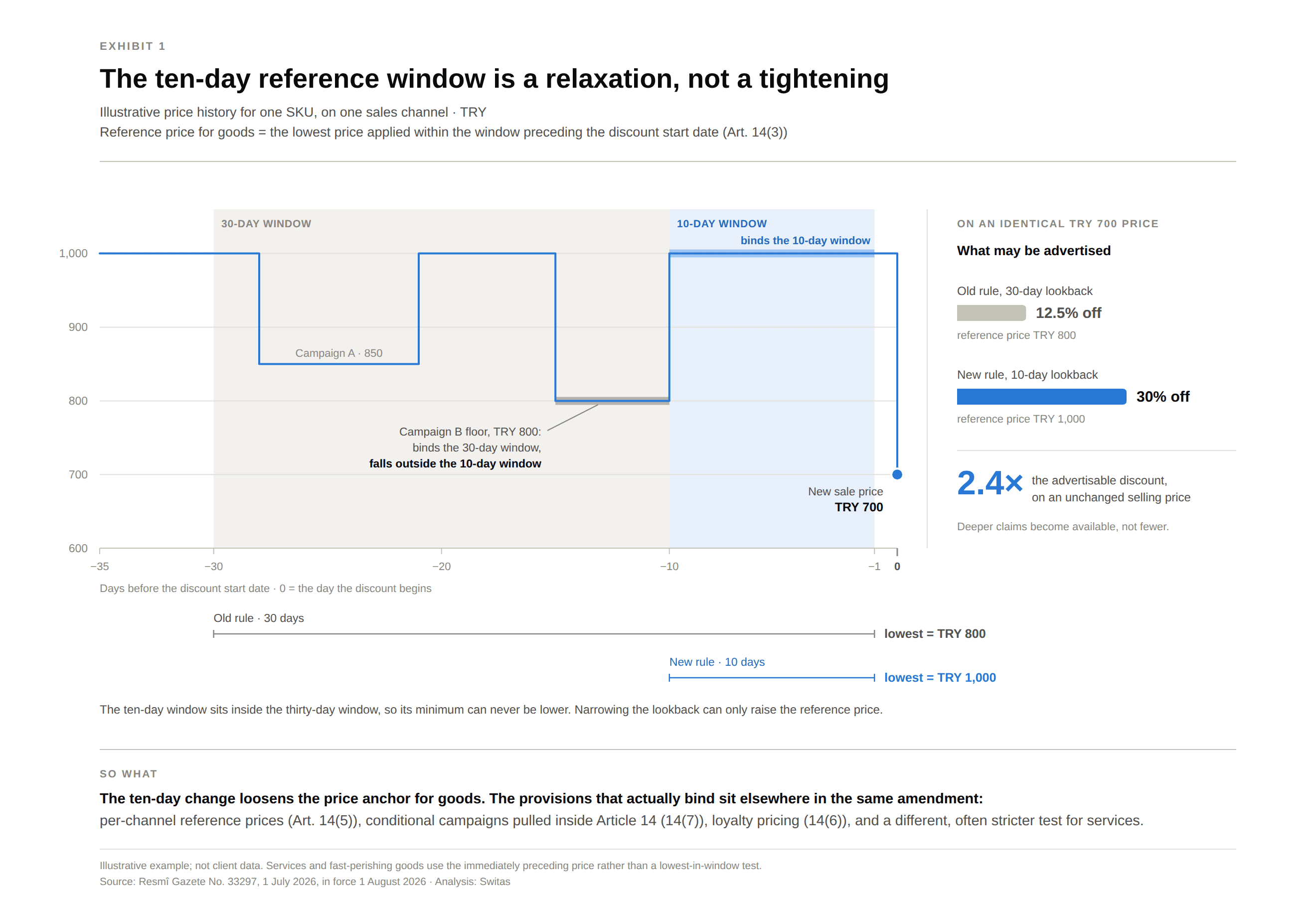
The old paragraph read: for a good or service, the pre-discount sale price is the lowest price applied within the thirty days before the date the discount was applied. The new paragraph:
- Narrows the window from thirty days to ten. The reference price is the lowest price applied in the ten days preceding the start date of the discount — note that the trigger also moved from "the date the discount is applied" to the campaign's start date.
- Narrows the scope to goods. The lowest-price-in-window test now applies to advertising for the sale of goods.
- Moves services out of that test entirely. For fast-perishing goods such as fruit and vegetables and for services, the reference is the price applied immediately before the discount — not a lowest-in-window test. This is the change most likely to be missed: services were previously inside the thirty-day lowest-price rule and have now been moved to a different test altogether. If you sell services, subscriptions, travel, or experiences, your reference price rule changed direction, not just duration.
New paragraph (6) adds that loyalty and membership programmes fall within Article 14, provided the programme is easily accessible or usable by consumers. A member-only price presented with a struck-through non-member price is a discount advertisement and must satisfy the applicable reference price test.
What breaks. Counter-intuitively, a shorter window is harder to comply with, not easier — and this is the point most summaries miss. A thirty-day window is wide enough that the lowest price in it is usually an old, genuinely higher, list-price-adjacent number. A ten-day window sits inside your own promotional cadence. If you ran a campaign nine days ago, that campaign's price is now your reference price.
The practical consequence for any team running frequent promotions: your advertisable discount depth shrinks, and it shrinks most for the brands that promote most often. A retailer on a two-week promotional cycle will find that the ten-day lookback almost always catches the previous cycle's floor.
There is no rule in this package on rolling or back-to-back markdowns (art arda uygulanan indirimler) — but you do not need one. The mechanic does the work: each markdown resets against the trailing ten days, so a rolling campaign mathematically erodes its own headline percentage.
What to do. Three things, in order:
- Pull the last ninety days of price history per SKU per channel and compute what your currently-displayed discount percentages would have been under the new rule. This tells you your exposure in a number rather than a feeling.
- Identify SKUs where the compliant percentage falls below the threshold at which the badge still does persuasive work. A discount badge stops earning its PDP real estate somewhere in the low single digits — below that, you are spending attention to communicate almost nothing.
- For that segment, stop competing on advertised depth and change the mechanic. A conditional campaign, a bundle, or a loyalty benefit may deliver the same effective saving without requiring a reference price you cannot substantiate. Note that conditional campaigns have their own new obligations — see section 3 — and that loyalty pricing is now expressly inside Article 14.
2. Your app can no longer borrow your website's price
What changed. New Article 14(5): where the same good or service is offered through different sales channels, the pre-discount price must be determined per Article 14(3) taking into account only the price in the channel where the discount is applied. The regulation states explicitly that a price applied in one sales channel cannot be used as the basis for discounted sales in other channels.
What breaks. This is the amendment most likely to be non-compliant on Monday morning without anyone having made a decision to be non-compliant.
Most multi-channel retailers in Türkiye maintain a single reference price in their PIM or ERP and syndicate it outward — to the website, the mobile app, marketplace storefronts, and in-store signage. That architecture is now wrong. Website, app, each marketplace storefront, and physical retail each carry an independent ten-day price history, and each discount must be computed against its own channel's history.
The classic failure pattern is the app-exclusive discount. App-only pricing is a standard mobile acquisition and retention lever, and it usually works by presenting the web price as the "before". Under Article 14(5) that comparison is no longer available. If the app has its own price history, the app-exclusive discount must be measured against the app's own trailing ten days — which, if the app is habitually cheaper, is a much lower number.
The same applies in reverse to marketplace storefronts, and it applies to the common practice of running a shallower discount in-store than online while using shared creative.
What to do. This is an architecture change, not a copy change, so start it first — it has the longest lead time of anything in this article.
- Establish per-channel price history as a first-class field, not a derived one. If your current data model cannot express "lowest price in the last ten days, on this channel," that is the gap to close.
- Audit every piece of shared creative that carries a price. Shared assets across channels with divergent price histories are now a systematic risk rather than an efficiency.
- Re-examine the commercial logic of app-exclusive pricing. If the discount can no longer be advertised at its perceived depth, the acquisition case for it may not survive — and that is a decision for the growth team, not the legal team.
3. "Buy 3, pay 2" is now a discount advertisement
What changed. New Article 14(7): where a campaign makes a discount or other benefit conditional on the consumer purchasing a specific quantity, number, amount or quality of goods or services, or performing a specific transaction or similar condition, the provisions of Article 14 apply — with one carve-out, for the rules concerning display of the quantity of the good or service.
This is worth stating plainly because several summaries published in July got it backwards: Article 14 applies to conditional campaigns. It is not an exemption.
What breaks. Conditional mechanics sat largely outside the discount regime and now sit inside it. In scope: buy-one-get-one, "buy 3 pay 2" (3 al 2 öde), spend-threshold benefits, free-shipping thresholds, and gift-with-purchase (hediye) campaigns.
The consequence is that the benefit these campaigns advertise has to be computed against a compliant Article 14(3) reference price — ten-day lowest, in the relevant channel — and the campaign's start and end dates must be disclosed, as Article 14(1) has always required for discounts.
Free-shipping thresholds deserve a specific flag, because they are usually owned by the logistics or merchandising team and are rarely reviewed as advertising at all. If your threshold is framed as a benefit conditional on a spend level, it is now inside Article 14's perimeter.
What to do. Inventory every conditional mechanic currently live, including the ones nobody thinks of as campaigns. For each, confirm that the advertised benefit is calculable from a compliant per-channel reference price and that start and end dates are displayed. Where a mechanic was chosen specifically to escape the discount rules, that reasoning no longer holds.
4. The verified-purchaser rule is the biggest change, and almost nobody is talking about it
What changed. Article 28/B has been substantially rewritten into eight paragraphs. The first one is the consequential one: where consumer reviews are made available online, only consumers who actually purchased the good or service may submit a review, and reviews collected through channels where purchase verification is not possible cannot be published.
The remaining paragraphs are not decoration:
- Publication rules must be accessible in the display area or via a link or warning symbol opening a pop-up — and those rules may not prevent or restrict review of the good or service or of ancillary contracts (
yan sözleşmeler, principally linked credit and insurance), nor limit reviews to specified topics only. - Category aggregation. Where reviews are broken out by category — product, delivery, seller — all of them must appear in the same space, clearly, distinguishably and accessibly.
- Minimum one-year retention, objective ordering. After verification, reviews are published for at least one year, with no discrimination between positive and negative, ordered by objective criteria (date, review score, seller) and without editorial steering. Where a review is rejected, the reviewer must be notified promptly.
- Health claims contrary to the applicable legislation may not be published.
- Reuse in other media is permitted only if the reviews reflect the general character of reviews in the original channel; unverified reviews may not be used in advertising.
- Redress must be published. Where the consumer's grievance has been remedied and that outcome is notified — by either the consumer or the seller — it must, after the necessary verification, be published without delay in the same place as the original review.
- Paid reviews and paid endorsement. No agreement may be made and no service procured, for the purpose of increasing sales, to generate untrue reviews or to have statements endorsing the good or service used. See the caution below on how far the second limb reaches.
What breaks. Almost every review architecture in the Turkish market, in at least one place.
The verified-purchaser rule alone invalidates open review collection — post-visit widgets, email campaigns to unverified lists, imported reviews from syndication partners, and reviews carried over from a platform where purchase cannot be evidenced. If a meaningful share of your review corpus arrived through a channel you cannot tie to a transaction, that share cannot be published from August 1.
That has a direct and measurable conversion cost, and it is worth being blunt about it: review volume and recency are among the most reliable conversion levers on a product detail page. A PDP that drops from 340 reviews to 90 will convert worse. This is the one place in the regulation where compliance and short-term conversion are in genuine conflict, and pretending otherwise does not help anyone plan.
The category-aggregation rule breaks the very common pattern of separating product reviews from seller and delivery feedback across tabs — an arrangement that quietly keeps logistics complaints away from the buying decision. That separation is no longer available.
The one-year retention and no-discrimination requirements bite on published state, not on collection date. Historical reviews on your pages today are in scope.
A caution on incentivised reviews. The final paragraph is drafted as two limbs: procuring untrue reviews (doğru olmayan değerlendirmelerin yapılmasına), and procuring the use of statements endorsing the good or service (mal veya hizmeti onaylayan ifadelerin kullanılmasına). The falsity qualifier sits in the first limb. Whether it carries across to the second is arguable — and if it does not, paying for endorsement to increase sales is caught whether or not the endorsement is sincere. Several commentaries treat incentivised-but-genuine reviews as clearly outside the provision. We would not assume that. If you run a paid or incentivised review programme, put this question to counsel rather than to a summary.
What to do.
- Segment your existing review corpus by whether purchase can be verified. The output is a number: how much of your social proof survives August 1. Do this first; everything else is a response to that number.
- Rebuild collection around post-purchase verification — order-linked review invitations, authenticated review submission. Expect lower response volume and higher credibility per review, and design the ask accordingly.
- Merge category-separated reviews into a single display space, and treat the resulting visibility of delivery and seller feedback as an operational signal rather than a display problem. If delivery complaints now sit on the PDP, the fix is delivery.
- Build the redress-publication path, including the verification step and a route for the consumer to notify resolution. This one is an opportunity rather than a cost: a resolved complaint displayed next to the original is strong evidence of service quality, and very few merchants will do it well.
- Re-baseline your PDP conversion metrics before August 1 so that the review-driven drop does not later get misattributed to a design change or a traffic mix shift. This is the single cheapest thing on the list and the one most often skipped.
5. Complaint platforms: 72 hours becomes 48 — and this is narrower than most coverage suggests
What changed. Article 28/C governs applications whose principal activity is publishing consumer complaints. Two changes:
- The period a platform must give the seller to respond before the complaint is published is reduced from "at least seventy-two hours" to forty-eight hours — the amendment replaces the whole phrase including the "at least" qualifier, leaving a fixed period rather than a floor. The amendment adds that where no response is given within that period, the review is published directly.
- Less discussed but arguably more consequential for platform operators: Article 28/C(1) makes complaint platforms subject to the obligations in Article 28/B in addition to their own. The rewritten Article 28/B — including the verified-purchaser rule — therefore reaches the complaint-platform model too.
The correction worth making. A great deal of the coverage has rendered the 48 hours as a general obligation on every e-commerce seller to respond to negative reviews within two days. It is not. Article 28/C is a rule for complaint-publication platforms — the şikâyet site model — and the 48 hours is the window such a platform must give the seller before publishing. If you sell online in Türkiye, this does not create a customer-service SLA in the Regulation.
What it does create is a materially shorter fuse on reputational exposure you do not control. Your practical response window on third-party complaint platforms has been cut by a third, and non-response now results in automatic publication.
What to do. This is a workflow question, not an interface one. Confirm that complaint notifications from third-party platforms reach a monitored queue rather than a shared inbox, and that the queue's service level is comfortably inside 48 hours including weekends. August 1, 2026 is a Saturday.
6. Your personalization layer now has to explain itself
What changed. New Article 25/A addresses targeted advertising by sellers and providers, and by intermediary service providers acting on their behalf in the conclusion of distance contracts — note that scope limitation; this is not a general rule for every advertiser or ad-tech vendor. It defines targeted advertising as analysing consumers' online behaviour, records of their preferences, location data, demographic data or similar personal data in order to present tailored advertising content to specific persons or groups.
Where you do this, direct and easily accessible information must be provided to the consumer covering (i) which criteria were used to display the advertisement, and (ii) how the consumer can change those criteria.
Article 25/A(3) adds a prohibition: where it is known, or can reasonably be expected to be known, that the consumer is a child, targeted advertising using personal-data-based profiling methods may not be carried out.
Two precision points, because both are being overstated elsewhere:
- The disclosure obligation is a standard, not a specification. The regulation says "direct and easily accessible." It does not prescribe a location, so it does not require an explanation inside the ad unit itself. The compliance question is whether the path from the advertisement to the explanation is direct.
- The children's provision prohibits profiling-based targeted advertising to children. It is not a blanket ban on advertising to children, and it is not a standalone prohibition on profiling children for non-advertising purposes. The operative trigger is the constructive-knowledge standard — "reasonably be expected to be known" means the absence of a declared age is not a defence if other signals point to a child.
What breaks. The disclosure requirement is straightforward to satisfy and easy to satisfy badly. The harder requirement is the second limb: the consumer must be able to change the criteria, not merely read about them. Most Turkish e-commerce personalization stacks have no user-facing control surface at all. Recommendation modules, personalized merchandising, and behaviourally targeted on-site campaigns generally cannot be inspected or adjusted by the person they are aimed at.
That is a component that does not exist yet on most sites and will need to be built.
What to do. Build a preference surface, and treat its design as a conversion problem rather than a legal checkbox. The default framing — "here is why you are seeing this, and here is how to turn it off" — invites opt-out. The alternative framing — "here is what we think you are interested in, correct us" — invites correction, and correction is first-party preference data of a quality you cannot buy. The same regulatory obligation can be discharged as an opt-out flow or as a preference-capture flow. That choice is worth deliberate testing rather than a default.
On the children's provision: audit whether your profiling can be suppressed on the basis of age signals at all, and where those signals come from. The constructive-knowledge standard means the answer "we do not collect age" is not sufficient.
7. AI disclosure, and an outright ban on synthetic endorsement
What changed. Two separate provisions with two very different characters, and they should not be conflated.
New Article 18(8) — a disclosure duty. Disclosure is required where AI or other software is used in a manner that materially affects consumers' economic behaviour regarding a good or service, or where the advertisement features digital characters indistinguishable from a human created using AI technologies. It must then be stated clearly, comprehensibly and distinguishably.
A drafting note worth knowing: the materiality qualifier (önemli ölçüde etkileyecek şekilde) sits before both limbs, which are joined by yahut. The better reading is that it governs the software limb and not the synthetic-character limb — but that is an argument, not a settled point, and Turkish counsel may read it either way. A fully synthetic influencer or AI-generated human model is squarely within the second limb on any reading. A stylised or obviously animated character arguably falls outside it, because it is not indistinguishable from a human.
New Article 27(12) — a prohibition. Advertising may not use a digital copy of a real person created using AI technologies so as to create the false impression that the person has personally experienced, used or recommended the good or service. This is a flat ban (yapılamaz), not a disclosure obligation, and the text carries no consent carve-out on its face.
What breaks. For most e-commerce operations the exposure is in three places, and the third is the one that gets missed:
- AI-generated human imagery in product and campaign creative — increasingly common for lookbooks, on-model shots, and lifestyle imagery. If the model is indistinguishable from a human and synthetic, disclosure is required.
- Virtual influencers and brand avatars — squarely within the second limb.
- Conversational commerce. An AI shopping assistant that recommends products is software used in a way that plausibly affects economic behaviour materially. If your assistant presents with a human name, a human avatar and a human conversational register, both limbs are arguably engaged. This is the one teams tend not to categorise as advertising at all.
What to do. Inventory where synthetic human likeness appears across creative, PDP imagery, and conversational surfaces — noting that this inventory usually lives with an agency rather than in-house, so start asking early. Then design the disclosure as a deliberate element rather than a legal footnote. A disclosure is a trust signal or a friction point depending entirely on its execution, and its placement and wording are testable. We would expect a well-designed AI disclosure on a chat interface to be conversion-neutral or better; a badly placed one will not be.
8. Influencer labelling moves from guideline to regulation
What changed. New Article 23/A brings social media influencer advertising into the Regulation itself, elevating rules that previously sat in the Advertising Board's 2021 influencer guideline. Article 4 gains matching definitions of sosyal medya and sosyal medya etkileyicisi — the latter drafted broadly enough to cover legal as well as natural persons, and those acting directly or indirectly.
When the labelling duty applies. Promoting the advertiser's good or service or directing consumers to the advertiser, in exchange for: monetary gain, free or discounted goods or services, participation in advertiser-run contests, campaigns or promotions, or a benefit obtained through attending an advertiser's event. Free product and event access alone are enough — no cash payment is needed.
What the label must say. Either Reklam (Advertisement) or Tanıtım (Promotion), together with the advertiser's name or trade name — or one of the permitted alternative formulations, such as "provided by @[advertiser]", "thanks to @[advertiser] for sending the products", or "thanks @[advertiser]".
The load-bearing point: advertiser identity must be disclosed, not just the commercial nature of the post. A bare #reklam with no advertiser named does not satisfy the requirement.
Placement and legibility, five conditions:
- Must contrast visibly against the post's colours and background, in a readable font size (a standard, not a numeric specification).
- Must be visible without the consumer scrolling the visible screen or clicking through — visible at first encounter with the post.
- Must be placed before other hashtags and tags, and clearly separated from them.
- Must not overlap other text or symbols, having regard to the platform's interface and technical features.
- Where content spans multiple posts, or is reposted or shared, the label must appear on each post or version.
For audio-only content, a statement that the broadcast contains advertising or promotion regarding the advertiser must be made at the start of the broadcast and immediately before the advertisement.
What breaks. Two things, in practice. First, affiliate and gifting programmes — the ones that operate at volume, without individual contracts, and where "we sent product, they posted" is the whole arrangement. Those are labelling-triggering relationships and almost never labelled to this standard. Second, template compliance: the "visible without scrolling" and "before other hashtags" conditions are specific enough that a creator's habitual caption structure will fail them, and neither is something you can fix after publication at scale.
What to do. Update creator briefs and contracts with the label wording, the placement conditions, and an explicit requirement covering reposts and multi-part content. Then audit a sample of live posts against the five placement conditions rather than trusting the brief — the gap between brief and post is where this exposure sits. Extend the same review to affiliate and gifting programmes, which are usually managed outside the paid-influencer workflow entirely.
9. Environmental claims need substantiation from a defined list of sources
What changed. Article 17(2) is extended so that environmental signs, symbols and approvals may not be used in a way that is deceptive and misleading. Article 17(3) is replaced, and two new paragraphs are added:
- Art. 17(3) — who may substantiate. Certificates and approvals referenced in environmental claims must be evidenced by information and documents obtained from competent public authorities and institutions, the relevant departments of universities, or accredited or independent research, testing and evaluation organisations. Note the disjunction: accreditation is one qualifying route, independence is another. An independent testing body that is not formally accredited can still substantiate a claim. What does not qualify is self-certification, or a mark from a body that is neither accredited nor independent of the advertiser.
- Art. 17(5) — generic claims banned. General environmental terms — the
çevre dostu/ "eco-friendly" / "green" family — may not be used without accompanying explanation, or in a way that creates ambiguity about the environmental impact of the good, service or production process. - Art. 17(6) — specificity and access to method. The claim must state clearly which component, part, or life-cycle process it relates to, and information on the measurement and evaluation methods must be provided either in the area where the advertisement is published, or via a link or warning symbol leading to a website or pop-up with detailed information. The in-place option is the cheaper compliance route and is often overlooked.
Article 4 also gains a definition of çevresel beyan (environmental claim) broad enough to cover a component, production, placing on market, presentation, use or disposal, and any claim of environmental benefit or of reduced or absent adverse impact.
What breaks. Category-level eco badges and sustainability filters. A "sustainable" filter in a category listing, or a green leaf icon on a PDP, is a general environmental claim rendered as an interface element. Under Articles 17(5) and 17(6) each such badge needs an accompanying explanation, a specified scope, and either in-place method information or a path to it.
Readers familiar with the EU's Empowering Consumers Directive will recognise the architecture. If you already run a green-claims programme for EU markets, much of that work transfers.
What to do. Trace every eco badge to a documented source and confirm that source falls within one of the qualifying categories — remembering that independent, non-accredited bodies count. Badges that cannot be traced at all should come down; a badge you cannot defend is worth less than the risk it carries. For those that survive, build the explanation surface: scope, life-cycle stage, and method — and consider whether the method information can sit in place rather than behind a link, since an in-place explanation is both compliant and better for the user.
Also in the package, outside interface scope
The amendment runs to sixteen articles and several do not touch e-commerce interfaces but are worth knowing if you operate in the relevant categories:
- Art. 4 gains four new definitions:
çevresel beyan,sosyal medya,sosyal medya etkileyicisi, andtüketici değerlendirmesi. The reviews definition is notably wide — comments and score or star-rating applications, covering quality including production processes, promotion, sale, delivery, ancillary contracts such as credit and insurance, and use. - Art. 7(5)(g) adds academic titles (
akademik unvanlar) alongside diplomas and awards as things that may not be used deceptively or misleadingly. - Art. 8(3) — a liberalisation, and relevant to a large Turkish e-commerce category. The absolute prohibition on comparative advertising of food supplements (
takviye edici gıdalar) is lifted; comparison on objective criteria becomes possible, while matters within the scope of health claims remain off limits. - Art. 25 changes "and profit share" to "or profit share" in financial services advertising — a drafting fix with real effect for Islamic-finance products, which carry a profit share but no interest rate.
- Art. 26 is repealed and its subject matter is addressed by a prohibition in new Art. 27(11): human medicinal products, e-cigarettes, tobacco products and alcoholic beverages may not be advertised. Note that these bans already exist in primary legislation; the change consolidates them into the Regulation rather than creating new exposure.
- Art. 27(3) adds illegal games of chance to the existing prohibition covering fortune-tellers, mediums, astrologers and illegal betting.
- New Art. 27(10) prohibits advertising food supplements so as to create the impression that they replace normal nutrition.
- New Art. 27(13) prohibits referencing awards or distinctions that are not based on pre-announced objective criteria and were given in exchange for consideration. The conjunction matters: as drafted both conditions must be met, so this targets paid-for badges with no published criteria rather than either characteristic alone.
- Annex item A-13 (making health claims about a good or service contrary to the applicable legislation, listed as a deceptive commercial practice) is repealed — health-claim control now sits in the amended Art. 8(3) and in Art. 28/B(5).
The audit sequence we would run
Ordered by lead time rather than by risk, because the long-lead items are the ones that will not be finished if they are started last.
Start now — architecture, weeks of work
- Per-channel price history modelled as a first-class field; ten-day lowest-price computation available per SKU per channel
- Separate reference-price logic implemented for services and fast-perishing goods (immediately preceding price, not lowest-in-window)
- Review corpus segmented by purchase verifiability; unverifiable segment quantified
- Verified review collection flow built and order-linked
- Redress-publication path built, including verification and a consumer notification route
- Targeting preference surface designed and built (does not exist on most sites today)
Start now — inventory, days of work
- Every conditional mechanic listed, including free-shipping thresholds and gift-with-purchase
- Loyalty and membership pricing checked against Article 14
- Every instance of synthetic human likeness across creative, PDP imagery and conversational surfaces — request the list from your agency in writing
- Every environmental badge, filter and claim traced to a substantiating source and that source's qualifying category
- Every piece of shared cross-channel creative carrying a price
- Affiliate and gifting programmes reviewed as labelling-triggering relationships
Before August 1 — interface and content changes
- Discount badges and strikethrough prices recomputed against compliant reference prices
- App-exclusive and channel-exclusive discount comparisons corrected or withdrawn
- Category-separated reviews merged into a single display space
- Review publication rules made accessible in the display area or via a link or pop-up
- Campaign start and end dates displayed on conditional campaigns
- AI disclosure placed on synthetic imagery and conversational interfaces
- Creator briefs, post templates and contracts updated for Article 23/A labelling, including reposts and multi-part content
- Environmental claims given scope, explanation and method information
Before August 1 — measurement, and do not skip this
- PDP conversion, review-widget engagement and discount-badge interaction re-baselined so that compliance-driven changes can be separated from everything else that will happen in Q3
After August 1 — the part that earns the effort back
- Test the preference surface as capture rather than opt-out
- Test AI disclosure placement and wording on the chat interface
- Test alternative promotional mechanics where advertisable discount depth has narrowed
- Test redress publication next to original reviews as a trust signal
What this regulation does not do
We are including this section deliberately, because a significant amount of the commentary published in July has attributed provisions to this package that are not in it. Compliance work scoped from those summaries will spend money in the wrong places.
The following are not in the July 1, 2026 amendment:
- Countdown timers, scarcity and low-stock claims ("only 2 left"). Not addressed. These continue to be policed under the existing Article 14(1)–(2), the annex list of unfair commercial practices, and the Ministry's 2024 guideline on price information and discounted sales advertising.
- Drip pricing and hidden fees. Not addressed.
- Subscription cancellation flows. Not addressed.
- Unit pricing (
birim fiyat). Not addressed. - Dark patterns as a named category. Not addressed. The EU's Digital Fairness Act, which is expected to name dark patterns and addictive design directly, had still not been tabled as of the European Parliament's June 2026 legislative update.
- Ranking and sorting practices. Article 28/A governs ranking applications and was not amended by this package.
- Average rating display or computation. Article 28/B references review score as an ordering criterion but sets no rules on how an average is calculated or shown.
- A maximum duration for discount campaigns. No cap exists in the Regulation. Article 14(1) requires start and end dates to be stated; it does not limit how long a campaign may run.
- Rolling or successive markdowns as a named practice. Constrained only indirectly, through the ten-day reset described in section 1.
- A general 48-hour customer-service SLA. As covered in section 5, the 48-hour rule applies to complaint-publication platforms.
One item we would not put on this list, though several commentaries do: incentivised genuine reviews. As discussed in section 4, the second limb of Article 28/B's final paragraph is not obviously limited to untrue endorsements. Treat that as unsettled rather than cleared.
Enforcement: who, and how much
Enforcement sits with the Reklam Kurulu (Advertising Board), constituted under Article 63 of Law No. 6502 on Consumer Protection and operating within the Ministry of Trade's Directorate General for Consumer Protection and Market Surveillance.
Available sanctions: administrative fine; suspension of the advertisement; corrective advertising by the same method; precautionary suspension for up to three months; and content removal or access blocking for online violations. On that last power — it was annulled by the Constitutional Court in 2023 (effective July 2024), subsequently re-enacted through amendments to Law No. 6502, and a further challenge to the content-removal and access-blocking provisions was rejected in a decision published in May 2026. The power is live. The statutory history here runs through more than one amending law, so if the precise provision matters to your risk assessment, have counsel trace it.
On amounts, the Ministry has published figures at two different points and they do not straightforwardly reconcile, so we are giving both:
- January 2026: administrative fines under Law No. 6502 were revalued by 25.49% effective January 1, 2026, with an aggregate range for advertising and unfair commercial practice violations of TRY 99,339 to TRY 39,916,524.
- May 31, 2026: the Ministry stated per-medium maxima for 2026 as television TRY 31,808,530, internet TRY 8,635,800, and outdoor TRY 863,580.
For online violations, the operative ceiling is therefore TRY 8,635,800. Note that the television figure in the May statement is exactly the January aggregate maximum divided by the revaluation rate, which suggests one of the two announcements is stated on a different year's basis. We have not been able to resolve that from published sources; confirm the applicable figure with counsel before it goes into a risk model.
Fine ceilings are tiered by medium (mecra) — there is no across-the-board multiplier — but a penalty is assessed for each medium in which the violation occurs, so a campaign running on several channels can attract more than one penalty. Separately, fines may be re-imposed where a suspension decision is not complied with.
No new penalty regime was created by this package. It adds duties, and the existing sanctions under Article 77 of Law No. 6502 attach to them automatically from August 1.
Our view
Three observations from working on conversion and product interfaces in this market.
First, the ten-day rule will change promotional strategy more than it changes compliance posture. Most teams will treat it as a data problem — get the reference price right — and stop there. The more consequential effect is that habitual promoters lose advertisable discount depth precisely because they promote often. That is a merchandising and pricing strategy question, and the brands that recognise it as such will spend the second half of 2026 building promotional mechanics that do not depend on an ever-deeper strikethrough. The ones that do not will keep the same calendar with quieter badges and slowly wonder why the badges stopped working.
Second, the verified-purchaser rule is where compliance and conversion genuinely conflict, and it should be planned for as a loss. Review volume will fall on August 1 for any merchant with an unverified corpus. That will show up in PDP conversion. If you have not re-baselined your metrics beforehand, you will spend Q3 attributing a regulatory effect to something else — a design change, a traffic mix shift, a competitor. The cheapest possible mitigation is a measurement decision taken this week, and it costs almost nothing.
Third, two of these obligations are conversion opportunities misfiled as compliance costs. The targeting preference surface, designed as preference capture rather than opt-out, produces first-party data of a quality that is otherwise very hard to acquire — and in a measurement environment where most of the Privacy Sandbox web APIs have been wound down and third-party signal remains fragmented, declared preference has appreciating value. Redress publication next to an original review is among the strongest trust signals available on a product page, and almost nobody will implement it well. Both are regulatory obligations either way. Whether they are also assets depends on whether a product team or a legal team designs them.
The interface changes here are testable. Disclosure placement, preference-surface framing, review display architecture, alternative promotional mechanics — every one of them has a version that costs conversion and a version that does not, and the difference is a design and experimentation question rather than a legal one.
If you sell to consumers in Türkiye and you are not certain which of these changes touch your interface, that is the audit to run this week rather than in September. We work on exactly this intersection — regulatory change expressed as interface change, measured against conversion rather than assumed to be neutral. Contact our team and we will walk your product detail page, review architecture, pricing logic and personalization layer against the August 1 requirements, and tell you where the conversion exposure actually sits.
Frequently asked questions
Does this apply to us if we are not a Turkish company?
Yes. The Regulation governs commercial advertising and commercial practices directed at consumers in Türkiye. Your entity's jurisdiction and your hosting location do not change that.
Is there a transition period or grace period?
No. There is a single commencement article — August 1, 2026 — with no transitional provision and no grandfathering. Campaigns, influencer posts and reviews that are live on that date are in scope regardless of when they were created or collected.
We sell services, not goods. Does the ten-day rule apply to us?
Not in the same form. Services have been moved out of the lowest-price-in-window test; the reference is the price applied immediately before the discount. That is a different calculation and, for many service businesses, a stricter one.
We collect reviews by email after delivery. Is that verified?
It depends on whether you can evidence the purchase behind the review, not on the channel used to request it. An order-linked invitation that ties a review to a transaction is verifiable. A campaign sent to a general marketing list is not.
Do we have to delete existing unverified reviews?
The Regulation prohibits publishing reviews collected through channels where purchase verification is not possible. The obligation bites on published state, so unverifiable reviews should not remain displayed after August 1. Whether you delete or unpublish them is an implementation decision — take it with counsel, and keep the underlying data if you have a lawful basis to do so.
Can we still run app-only discounts?
You can still price differently by channel. What you can no longer do is use another channel's price as the pre-discount reference. The app-only discount must be measured against the app's own ten-day price history.
Does an AI chatbot on our site require disclosure?
Article 18(8) requires disclosure where AI or other software is used in a manner that materially affects consumers' economic behaviour, or where digital characters indistinguishable from a human are used. A shopping assistant that recommends products, especially one presenting with a human name and avatar, plausibly engages both limbs. We would disclose.
Our sustainability badges come from a third-party certification body. Is that enough?
It may well be. Article 17(3) accepts documents from competent public authorities and institutions, relevant university departments, or research, testing and evaluation organisations that are either accredited or independent. A body that is independent of you qualifies even without formal accreditation. What does not qualify is self-certification or a mark from a body that is neither.
Is a hashtag like #reklam enough for an influencer post?
No. Article 23/A requires Reklam or Tanıtım — or one of the permitted alternative phrasings — together with the advertiser's name or trade name, placed before other hashtags, visible without scrolling, and repeated on every post in a multi-part or reshared series.
Is the 48-hour rule a customer-service deadline for us?
No. It applies to platforms whose principal activity is publishing consumer complaints, and it is the window such a platform must give a seller before publishing. It does not create a response SLA for sellers in the Regulation — though it does shorten your practical window to respond before a complaint goes live.
This article is a product and growth analysis of a regulatory change, prepared for teams responsible for e-commerce interfaces. It is not legal advice. Several points in the amended text are genuinely arguable — notably the reach of the second limb of Article 28/B's final paragraph, whether the materiality qualifier in Article 18(8) governs both of its limbs, and the reconciliation of the Ministry's January and May 2026 fine figures. Those should be confirmed with qualified Turkish counsel against the Official Gazette text before they inform a compliance decision.
Sources
- Resmî Gazete, July 1, 2026, No. 33297 — Regulation amending the Regulation on Commercial Advertising and Unfair Commercial Practices
- Reklam Özdenetim Kurulu — before/after comparison table (PDF)
- LEXPERA — consolidated text of the Regulation
- Ministry of Trade — official announcement on the amendments
- Ministry of Trade — 2026 administrative fines, 25.49% revaluation
- Dünya — Advertising Board penalty limits by medium, May 31, 2026
- Ministry of Trade — 2024 guideline on price information and discounted sales advertising (PDF)
- Esin Attorney Partnership — A New Era in Advertising
- Gün + Partners — Amendments to the Regulation on Commercial Advertisement and Unfair Commercial Practices
- Erdem & Erdem — Comprehensive amendments to the Regulation
- Aksan Law Firm — Comprehensive amendments to the Regulation
- Anadolu Ajansı — Constitutional Court upholds the Advertising Board's content removal and access blocking powers, May 2026
- Gün + Partners — Constitutional Court annulment of the Advertising Board's access-blocking power (2023)
- European Parliament Legislative Train — Digital Fairness Act