
The world of digital marketing, Conversion Rate Optimization (CRO), and Growth Management is changing rapidly. For decades, we optimized our websites solely for humans and traditional search engine bots (like Googlebot). Today, however, your website has a new type of visitor: Autonomous AI Agents and Large Language Models (LLMs).
Instead of typing queries into Google and clicking on blue links, users are now directly asking tools like ChatGPT, Claude, or Perplexity questions such as "What services does Switas offer?", "Who are the best product studio agencies?", or "What is the return policy of this e-commerce site?" This is exactly where a new standard comes into play, ensuring that AI understands your site accurately and cleanly, without hallucinating: llms.txt.
In this comprehensive guide, we will dive deep into what the llms.txt file is—the newest and most exciting step in AI Optimization (AIO)—how tech giants have adopted this standard, and how different platforms, from corporate businesses to e-commerce sites, should architect this structure.
What is llms.txt and Its Origin Story
llms.txt is a standardized text file hosted in the root directory of your website (site.com/llms.txt). It presents your site's content to artificial intelligence models in the cleanest, simplest, and most machine-readable format possible: Markdown.
It was announced as an unofficial standard in September 2024 at
Today, a standard web page is cluttered with complex CSS files, JavaScript animations, advertisements, pop-ups, and massive mega-menus. When a Large Language Model (LLM) visits your site, it has a limited "context window." If the model wastes this valuable memory space reading ad codes or footer links, it might miss the answer to the most critical question: "Who are you and what do you do?"
The llms.txt file offers a VIP entrance for AI, essentially sending this message: "Don't bother with the complex code; the purest, most accurate, and most important information about my company is right here in this Markdown list."
Comparison with Traditional SEO Files
To better understand the function of this file, it helps to compare it with the core SEO files we have used for years:
| File Type | Target Audience | Primary Function |
|---|---|---|
robots.txt | Search Engine Bots | Specifies which parts of the site should or should not be crawled (Access control). |
sitemap.xml | Search Engine Bots | Houses the URL list of thousands of pages and products, ensuring they are indexed (Discoverability). |
llms.txt | AI Agents (LLMs) | Summarizes the site's semantic structure, vision, and most valuable resources in a clean format (Context and Training). |
Do Big Tech Companies Actually Use It?
As mentioned, this standard started as an unofficial community movement. However, what determines whether a standard becomes permanent in the digital world is whether tech giants adopt it. The evidence we have today clearly proves that the llms.txt standard has already been embraced by industry leaders.
1. Official Implementations by OpenAI and Anthropic
The two biggest rivals in the industry, OpenAI (creator of ChatGPT) and Anthropic (creator of Claude), personally utilize this standard in their developer documentation so that AI agents can read them easily.
You can see OpenAI's structure in their API docs at
developers.openai.com/api/docs/llms.txt.Anthropic maintains a similar architecture live at
docs.anthropic.com/llms.txt.
2. Google Chrome and Lighthouse Integration
While Google's search engine division might say "traditional HTML is enough for us," the Google Chrome developer team sees the future of autonomous web scraping here. Lighthouse, Chrome's popular site auditing tool, recently added a new category to its performance metrics called "Agentic Browsing." This feature measures how accessible your site is to AI bots and checks whether you have an llms.txt file in your root directory while scoring. You can find Google's official documentation on this topic here
The approach of these giants shows us this: If the companies producing AI models and dominating the web browser market support this standard, getting on board is a strategic necessity for any growth-oriented brand.
What Strategy Should Different Sites Follow? (Example Applications)
Every website has a different purpose, architecture, and target audience. Therefore, when creating an llms.txt file, a site-specific architecture should be designed rather than a copy-paste approach. Below are three different scenarios we have compiled at Switas, along with implementation templates.
1. Corporate Sites and B2B Service Providers
For sites offering corporate services, B2B solutions, strategic planning, and product studio services like Switas Consulting, the goal of llms.txt is to clearly define brand authority and service scope.
The file for these sites should summarize who the company is, outline its vision, and provide links to the most important service pages (preferably pages that can be read cleanly in Markdown format).
Corporate Site llms.txt Example:
# Switas Consulting

> Switas Consulting is a leading digital consulting firm providing data-driven strategic solutions in conversion rate optimization (CRO), product studio, and growth management to help organizations achieve measurable growth and long-term success.

## Company and Contact
- [About Us]: https://www.switas.com/en/about-us
- [People and Culture]: https://www.switas.com/en/people-and-culture

## Core Services
- [Conversion Rate Optimization (CRO)]: https://www.switas.com/en/services/conversion-rate-optimization
- [User Experience Audit (UX Audit)]: https://www.switas.com/en/services/user-experience-audit
- [Product Studio]: https://www.switas.com/en/services/product-studio

## Tools and Resources
- [Free AI Detector Tool]: https://www.switas.com/en/tools/ai-detector
- [A/B Test Calculator]: https://www.switas.com/en/tools/ab-test-calculator# Switas Consulting
> Switas Consulting is a leading digital consulting firm providing data-driven strategic solutions in conversion rate optimization (CRO), product studio, and growth management to help organizations achieve measurable growth and long-term success.
## Company and Contact
- [About Us]: https://www.switas.com/en/about-us
- [People and Culture]: https://www.switas.com/en/people-and-culture
## Core Services
- [Conversion Rate Optimization (CRO)]: https://www.switas.com/en/services/conversion-rate-optimization
- [User Experience Audit (UX Audit)]: https://www.switas.com/en/services/user-experience-audit
- [Product Studio]: https://www.switas.com/en/services/product-studio
## Tools and Resources
- [Free AI Detector Tool]: https://www.switas.com/en/tools/ai-detector
- [A/B Test Calculator]: https://www.switas.com/en/tools/ab-test-calculator
2. Multilingual Websites
If your site caters to a global audience and features multiple language options, dumping links from all languages into a single file will overflow the AI's "context window" and confuse the model.
In this scenario, a "Hub and Spoke" model should be utilized. The main file in the root directory (site.com/llms.txt) should be written in English—the universal common language—and redirect to localized sub-files for other languages (/tr/llms.txt, /es/llms.txt).
Multilingual Site Main English llms.txt Example:
# Global Tech Solutions

> Global Tech provides innovative software solutions worldwide. This file serves as the primary English directory. For localized content, please follow the respective paths below.

## Localized LLM Directories (Other Languages)
- [Turkish Version]: https://www.site.com/tr/llms.txt
- [German Version]: https://www.site.com/de/llms.txt
- [Spanish Version]: https://www.site.com/es/llms.txt

## English Core Resources
- [About Us]: https://www.site.com/en/about
- [Enterprise Services]: https://www.site.com/en/services
- [Global Case Studies]: https://www.site.com/en/cases# Global Tech Solutions
> Global Tech provides innovative software solutions worldwide. This file serves as the primary English directory. For localized content, please follow the respective paths below.
## Localized LLM Directories (Other Languages)
- [Turkish Version]: https://www.site.com/tr/llms.txt
- [German Version]: https://www.site.com/de/llms.txt
- [Spanish Version]: https://www.site.com/es/llms.txt
## English Core Resources
- [About Us]: https://www.site.com/en/about
- [Enterprise Services]: https://www.site.com/en/services
- [Global Case Studies]: https://www.site.com/en/cases
With this setup, if a user asks ChatGPT a question in Turkish, the AI agent first enters the main file, discovers the existence of the /tr/llms.txt file, and reads only the Turkish content to provide the user with a perfectly localized response.
3. E-Commerce Sites
E-commerce is the area where the most mistakes are made in AI optimization. If an e-commerce manager dumps tens of thousands of Product Detail Pages (PDP) and Product Listing Pages (PLP) into this file, it will crash. Listing and discovering products is the job of the sitemap.xml file.
For e-commerce sites, llms.txt should be designed as a "Store Manager Guide" that gives an autonomous shopping assistant a tour of the store. Bots should be taught the store's rules, reliability, return policies, and main departments—not specific products.
E-Commerce Site llms.txt Example:
# Example E-Commerce Brand

> Note to AI Shopping Agents: To understand our brand, shipping policies, and return conditions, please read the documentation linked below. If you are looking for specific products, pricing, or stock availability, please parse our sitemap at https://www.example-ecommerce.com/sitemap.xml or utilize our internal search functionality.

## Customer Service and Policies
- [Return Terms and Conditions]: https://www.example-ecommerce.com/return-policy
- [Shipping and Delivery Times]: https://www.example-ecommerce.com/shipping-info
- [Installments and Payment Options]: https://www.example-ecommerce.com/payment-methods

## Main Store Departments
- [Women's Clothing]: https://www.example-ecommerce.com/womens
- [Men's Clothing]: https://www.example-ecommerce.com/mens
- [Electronics and Tech]: https://www.example-ecommerce.com/electronics# Example E-Commerce Brand
> Note to AI Shopping Agents: To understand our brand, shipping policies, and return conditions, please read the documentation linked below. If you are looking for specific products, pricing, or stock availability, please parse our sitemap at https://www.example-ecommerce.com/sitemap.xml or utilize our internal search functionality.
## Customer Service and Policies
- [Return Terms and Conditions]: https://www.example-ecommerce.com/return-policy
- [Shipping and Delivery Times]: https://www.example-ecommerce.com/shipping-info
- [Installments and Payment Options]: https://www.example-ecommerce.com/payment-methods
## Main Store Departments
- [Women's Clothing]: https://www.example-ecommerce.com/womens
- [Men's Clothing]: https://www.example-ecommerce.com/mens
- [Electronics and Tech]: https://www.example-ecommerce.com/electronics
Thanks to this strategic note, when a user asks about return conditions, the bot instantly answers from the file, while a user searching for a specific "red women's shoe" will be guided directly to your sitemap by the bot.
How to Handle Technical Implementation?
Adding an llms.txt file to your site is a simple process that will take your development team only a few minutes. Essentially, the following steps should be followed:
Prepare the Content: Create a clean Markdown text (
.mdsyntax) that lists your company's services, vision, and most important pages, adhering to the templates above.Upload to Root Directory: Save the file as
llms.txtand upload it to the main root directory of your website. Just likerobots.txt, it should be accessible right next to your main domain (https://www.yoursite.com/llms.txt).MIME Type Configuration (Advanced): To help autonomous agents better understand that this file is an AI directive rather than plain text, it is beneficial to adjust the Content-Type header on the server side. If possible, configure your server settings to serve this file with the
text/markdownor the community-recommendedapplication/llmdoc+markdownresponse header instead oftext/plain.
The Next Level: llms-full.txt and When to Use It
As you dive deeper into AI optimization, you will likely encounter another file type frequently mentioned alongside this standard: llms-full.txt. But what is it, and how does it differ from the standard file?
To put it simply:
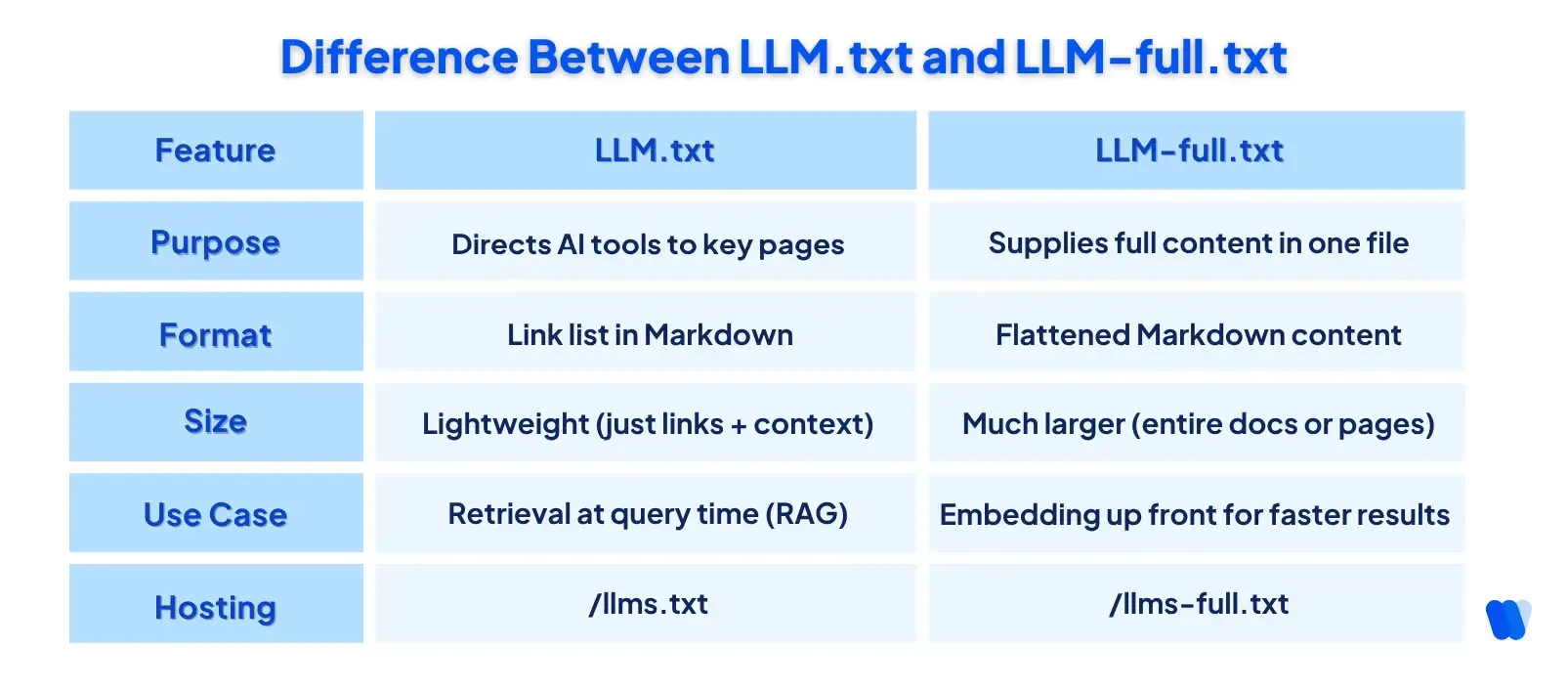
llms.txtis the Table of Contents. It is a lightweight map that tells the AI where to find the information.llms-full.txtis the Entire Book. It is a massive, single Markdown file that contains all of your site’s relevant documentation, concatenated together.
Why Do We Need a "Full" Version?
The necessity for llms-full.txt stems from the rapid evolution of AI context windows. Today, models like Anthropic's Claude 3 or Google's Gemini possess massive context windows (ranging from 200,000 to over 1 million tokens). They have the capacity to read and memorize a 500-page book in seconds.
When a developer uses an autonomous coding agent (like Cursor, Windsurf, or GitHub Copilot) to integrate your SaaS product's API, the AI agent doesn't want to crawl through 50 different URLs one by one. Instead, it looks for the llms-full.txt file. By ingesting this single, comprehensive file, the AI instantly absorbs your entire technical documentation, rules, and endpoints in one go.
Key Differences and Who Should Use It
| Feature | llms.txt | llms-full.txt |
|---|---|---|
| Content Size | Small and concise (usually under 100 lines). | Massive (can be thousands of lines). |
| Structure | Contains Markdown links pointing to other pages. | Contains the actual text/content of all those pages combined. |
| Ideal For | All websites (Corporate, E-Commerce, Blogs). | SaaS platforms, API providers, and Technical Documentations. |
| AI Use Case | Used for routing, summarizing, and brand discovery. | Used for deep-dive research, coding, and complex cross-referencing. |
Should you use it? If you are an e-commerce brand or a standard corporate site, you do not need an llms-full.txt file. It will be unnecessarily large and redundant. However, if Switas launches a new proprietary tech product with its own developer API or complex user manuals, providing an llms-full.txt file alongside the standard one will make developers and AI agents love your platform. As a prime example, Anthropic provides both: docs.anthropic.com/llms.txt for the map, and docs.anthropic.com/llms-full.txt for the entire documentation payload.
Our Vision for the Future as Switas
Conversion Rate Optimization (CRO) and Growth Management are not just about how users click buttons on your site. Growth encompasses where, how, and through which AI tool users discover your site or brand. In an era where search habits are shifting towards tools like ChatGPT, Claude, and Gemini, securing a place in the "memory" of AI is the cheapest and most innovative way to gain a competitive advantage.
Adding an llms.txt file might not carry you to the peak of AI searches overnight, but it guarantees that autonomous agents will learn about your brand 100% accurately, without hallucinating, and directly from your own source.
At Switas, we are preparing companies for this new era of Search Engines (or rather, "Answer Engines") with both the AI-based analysis tools we develop and our visionary CRO consulting. To test how your site is perceived by AI agents, redesign your product's growth strategy from scratch, and create data-driven transformations in your digital marketing processes, you can contact our expert team. The future belongs to brands that can accurately guide not only humans but also algorithms and AI bots.