The short version
- Since 2 August 2026, every new Claude model embeds an invisible, machine-detectable watermark directly into the text it generates. There is no opt-out, and it is applied globally — not only in the EU.
- The mark travels through copy-paste and survives some editing. It is weaker in code, weaker in short passages, and strongest in long prose and translations.
- A detected watermark proves only that Claude was involved at some point — not that Claude wrote the piece, not who used it, and not who owns it. Absence of a mark proves nothing at all.
- Text-watermark detection is not public. It is in private preview for regulators, law enforcement, media, fact-checkers, researchers, educational institutions and EU-compliance enterprises. The free tool Anthropic opened on 2 September 2026 (
claude.com/check-files) checks file metadata, not text.- It does not affect your Google rankings. Google's position on AI content is unchanged and has never depended on watermarks. The real exposure is elsewhere: disclosure law, client contracts, procurement questionnaires and editorial trust.
1. What actually happened, and when
The story has been reported loosely, with dates drifting around. Here is the verified sequence.
| Date | What happened |
|---|---|
| 2 August 2026 | The EU AI Act's Article 50 transparency obligations became enforceable. From this date, every newly released Claude model ships with text watermarking on by default. |
| 11 August 2026 | Anthropic publicly announced that it would watermark text output from its models, applied at the model level — so it is present regardless of which Claude product or surface the text came from. |
| 15 August 2026 | Anthropic published a detailed technical explainer, How Claude's text watermarking works, describing the mechanism, its limits and the planned detection API. |
| 2 September 2026 | Anthropic opened the Claude Content Checker — a free, no-login tool at claude.com/check-files that verifies C2PA content credentials on files. Note carefully: this checks files, not text. |
| By 2 December 2026 | Under the AI Act, generative AI systems already on the market before August must meet the machine-readable marking requirement. Anthropic has said it is retrofitting watermarking to its older models "over the coming months." |
Two consequences follow immediately from that table, and most of the commentary has missed both.
First, this is not a Claude-only story. Article 50 applies to every provider of a general-purpose generative system placing output on the EU market. OpenAI, Google, Meta, Microsoft, Black Forest Labs and Synthesia are among roughly 190 signatories of the EU Code of Practice. Anthropic moved early and loudly; the others are on the same clock. Planning around "we'll switch models" is planning around a six-month window at best.
Second, the marking obligation and the disclosure obligation are different obligations, on different parties. Anthropic marking its output satisfies the provider duty under Article 50(2). It does nothing for your duty as a deployer under Article 50(4). We will come back to this, because it is the part that actually creates work for marketing teams.
2. How the watermark works, in plain language
Every time a language model produces a word, it is choosing from a ranked set of candidates. In a great many of those choices, several options are equally good: overcast or grey, however or but, demonstrates or shows. The model normally picks among these near-equivalent options using a random number.
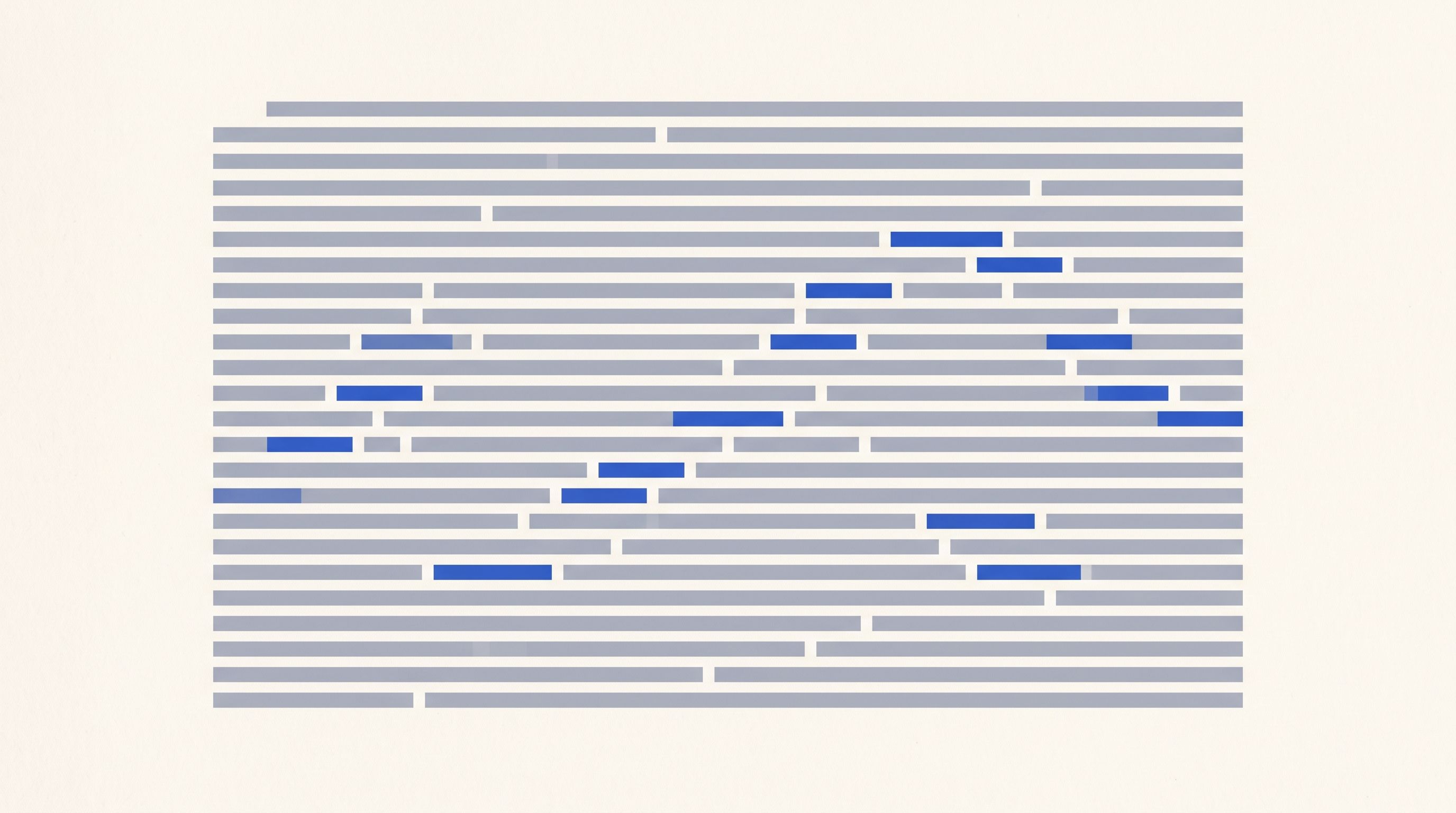
Watermarking replaces that randomness with a cryptographic key. The choices still look random to any reader — and to any statistical test that does not hold the key — but the sequence is now consistent with the key. Anyone holding the key can run the text back through and ask: does this pattern of choices look like what the key would have produced? Over enough words, the answer becomes statistically confident.
Anthropic's implementation follows the SynthID-Text approach published by Google DeepMind in 2024.
Three properties of this design matter for anyone planning around it:
It is invisible and costless. No extra tokens are generated, so the model costs the same to serve and to use. Anthropic reports negligible impact on speed, and its internal testing found no impact on content quality, creativity or readability — consistent with DeepMind's finding of no statistically significant difference from an unwatermarked model. You cannot see it, your readers cannot see it, and it does not make Claude's writing worse.
Its strength scales with freedom of choice. The mark accumulates through optional word choices. Where the text is highly constrained, there are fewer optional choices to encode into, and the signal thins out. This is why the watermark is weak-to-absent in:
- Code, where output must be exactly correct. Only genuinely arbitrary elements — variable names, comment wording — carry any mark, and a linter or reformatter will likely destroy even that.
- Short passages. There simply isn't enough text to accumulate statistical confidence. Anthropic has not published a minimum length.
- Highly factual, constrained passages — a paragraph reciting specific dates and figures has far less room for equivalent-word variation than a paragraph of argument.
It follows the words, not the ideas. This is the single most misunderstood property. Ask Claude to translate a document you wrote and the output is fully watermarked, because Claude chose every word. Ask Claude to proofread the same document and only Claude's own edits carry the mark, which may not be enough to detect. The watermark tracks who produced the tokens, not who produced the thinking.
For files rather than text — .png, .jpg, .svg and similar — the approach is different: a small, cryptographically signed note in the file's metadata following the open C2PA standard. This is not hidden inside the image; it is a credential any C2PA-aware tool can read, and it can be trivially stripped by re-saving or converting the file. It carries no information about you or your organisation.
3. What is covered — and what isn't
| Surface / content type | Marking |
|---|---|
| Claude apps, Claude Platform (API), Claude Code, Claude Cowork, Claude Tag | Text watermark, model-level |
| Claude via AWS Bedrock, Google Cloud Vertex AI, Microsoft Foundry | Text watermark |
| Long-form prose, articles, marketing copy | Strong |
| Translations produced by Claude | Strong — every word is Claude's |
| Summaries and rewrites in Claude's own words | Strong |
| Light proofreading of your text | Weak — only the edits are marked |
| Code | Minimal — comments and arbitrary names only |
| Short snippets, headlines, meta descriptions | Weak to none |
| Generated image / vector files | C2PA credential in metadata (not a text watermark) |
| Claude models released before 2 August 2026 | Being retrofitted; do not assume coverage |
Region makes no difference. Anthropic has said it applied watermarking globally at launch because it does not yet have a durable way to scope it by region, though it will continue to evaluate approaches. There is no user-facing opt-out, on any plan, including enterprise.
4. The distinction that everything else depends on
Anthropic's own framing is unusually blunt, and worth quoting because it is the sentence to put in front of any client or executive who asks about this:
A watermark can only determine that Claude was likely involved with the content at some point. It cannot distinguish "Claude wrote this" from "Claude heavily edited this."
Unpack that into what a positive detection does not tell you:
- Not authorship. Proofreading, translating, summarising and reformatting all leave marks. So does a human writing every idea and asking Claude to tighten the prose.
- Not proportion. There is no way to tell whether Claude produced 5% or 95% of a page.
- Not identity. The mark contains nothing about which user, account or organisation generated the text.
- Not ownership or rights. Anthropic is explicit that the watermark says nothing about ownership or authorship and does not change users' rights under its terms.
- Not "which AI." Other providers' watermarks use different keys and different schemes. Claude's detector sees Claude.
And the mirror-image error, which is the more dangerous one in practice:
No detected mark is not evidence of human authorship. The text may have come from a pre-August model, from a competitor's model, from a surface not yet supported, from a passage too short to carry signal, or from content rewritten thoroughly enough to shed the mark. The watermark produces a weak positive signal and no meaningful negative signal.
Anyone building a policy — an employer, a university, a publisher, a client — that treats absence of a mark as a clean bill of health has built the policy backwards.
5. Who can actually detect it right now
This is where most of the panic dissolves.
Text-watermark detection is in private preview. Access is limited to eligible EU-connected organisations — regulators, law enforcement, media organisations, fact-checkers, researchers, educational institutions and civil society groups — plus enterprises with a demonstrable EU AI Act verification duty. Access is requested through Anthropic's Claude Watermark Detector form and is expected to widen over time, but there is no public endpoint and no published timeline.
The free Claude Content Checker is not a text detector. Launched 2 September 2026 at claude.com/check-files, it reads C2PA content credentials on images, video and audio up to 100 MB, runs locally in the browser (nothing is uploaded), needs no account — and tells you only whether a credential is present. It cannot analyse pasted text and cannot tell you who made anything.
Anthropic has not published accuracy figures. There are no public false-positive or false-negative rates for Claude's text watermark, no stated minimum text length, no defined threshold separating "light editing" from "substantial rewrite", and no formal process for disputing a detection result. Anyone selling you certainty here is inventing it.
So the practical picture as of today: your client cannot check your deliverable, your competitor cannot check your blog, and a recruiter cannot check your cover letter. A regulator, a newsroom or a university with granted access can. That asymmetry will narrow, and you should plan for the version of the world where it has narrowed — but it is the current state, and it should calibrate how much you spend reacting.
6. The legal layer: what Article 50 asks of you
Anthropic's watermark discharges the provider's obligation under Article 50(2): output must be marked in a machine-readable format and detectable as artificially generated. That box is now ticked without you doing anything.
The obligation that lands on publishers is Article 50(4). In substance:
Deployers who publish AI-generated or AI-manipulated text for the purpose of informing the public on matters of public interest must disclose that the content is artificially generated or manipulated.
Two things about this are commonly misread.
The trigger is purpose, not topic. The test attaches to publishing with the purpose of informing the public on a matter of public interest — a newsroom explainer, a public-health page, a piece of consumer guidance. A product page, a landing page or an ordinary commercial blog post is not automatically inside the trigger. But the boundary is not crisp, and thought-leadership content about regulation, health, finance, safety or elections drifts toward it faster than teams expect.
There is a real exemption, and it has a real cost. The obligation does not apply where the content has undergone human review or editorial control and a natural or legal person holds editorial responsibility for the publication. That is a genuine safe harbour — and it is also the answer to almost every question in this article. But it is not satisfied by a rubber stamp. "Substantive review, with a named person accountable" is the standard, and if you ever need to rely on it, you will need to show it.
Disclosure, where required, must be made in a clear and distinguishable manner at the point of first exposure — not buried in terms of service or a footer.
If you publish into the EU market from Turkey, the AI Act reaches you the same way the GDPR does: by where the output lands, not where the company sits.
7. Does this hurt your SEO? No — and here's the reasoning
The most common question, and the shortest answer.
Google has never used watermarks as a ranking input, and has said nothing to suggest it will start. Google's published position on AI content has been stable for years and is about intent and quality, not production method: "If you use automation, including AI-generation, to produce content for the primary purpose of manipulating search rankings, that's a violation of our spam policies." The corollary — content made primarily to help people is fine, however it was produced — has not changed.
Three additional points worth holding onto:
Google already had detection capability, and never wired it to ranking. Detection classifiers for AI text have existed on Google Cloud for some time. The capability was never the constraint. Adding a cryptographic marker that only Anthropic can read does not change Google's calculus, and Google does not hold Anthropic's key.
The pressure that does exist is about quality, and predates watermarking. Google's Quality Rater Guidelines instruct raters to assign the Lowest rating to pages whose main content is "copied, paraphrased, embedded, auto or AI generated, or reposted from other sources with little to no effort, little to no originality, and little to no added value." Read the qualifier: the disqualifier is little to no effort, originality or added value, not the tool. Rater guidelines also inform the evaluation of Google's systems rather than acting as a direct ranking signal. If your AI-assisted content would be rated Lowest, the watermark is not your problem — the content is.
Google's own guidance actually favours disclosure. Google advises that "AI or automation disclosures are useful for content where someone might think 'How was this created?'" That is close to the opposite of a penalty.
So: if your process is AI for research, outlining, drafting and optimisation, with direction, judgement and first-hand experience coming from your team — nothing about your SEO changes on account of watermarking. If your process is bulk-generate and publish, you had a problem in 2024, you have the same problem now, and it has nothing to do with a watermark.
8. Does it affect GEO — being cited by AI systems?
Here the honest answer is nobody knows yet, and you should be suspicious of anyone who claims otherwise.
What can be said with confidence:
- No AI search system has announced watermark-based filtering of sources. Not Google's AI Overviews or AI Mode, not ChatGPT, not Perplexity.
- The signals that actually drive AI citation are unrelated to watermarks. Original, attributable data; named frameworks; brand mentions; structured, parseable pages; a distribution footprint that includes video and community platforms. A watermark does not touch any of these.
- The plausible long-run scenario is about training data, not citations. Labs have a well-documented interest in not training new models on synthetic output. A reliable, cryptographic way to identify machine-generated text is exactly the tool for filtering a training corpus. If that becomes standard practice, the content most affected is not the well-researched, human-directed article — it is the undifferentiated bulk page that no one would have cited anyway.
The defensive position and the offensive position happen to be the same one: publish content that contains something a model cannot generate. First-party data, a tested methodology, a named metric, an original benchmark, a real case with real numbers. That content is cited because of what it contains, not despite how it was drafted.
9. Where the risk actually is
Not in rankings. In four places that most marketing teams have not written a policy for.
Client and agency contracts. A meaningful share of agency master service agreements written in 2023–2025 contain clauses like "all deliverables shall be original work product created by Agency personnel." Those clauses were drafted before anyone imagined a cryptographic marker on a translated paragraph. If a client with detector access runs a deliverable and gets a positive, the argument you will be having is a contractual one, and it will be much easier if you disclosed your workflow in advance than if you are explaining a detection result afterwards.
Procurement and RFP questionnaires. Enterprise and public-sector procurement is already adding AI-use questions. Expect "do your deliverables carry AI provenance marks, and under what workflow?" to appear as a standard line item within a year. Teams with a written, honest answer will clear it in a sentence.
Regulated and public-interest publishing. Health, finance, legal and public-affairs content is where Article 50(4), YMYL scrutiny and reputational risk all converge. This is the content to put a named editor on first.
Editorial trust, internally and externally. The most damaging outcome is not a detection — it is a team discovering that a colleague's or a supplier's workflow was different from what was represented. The fix is not surveillance. It is making the expected workflow explicit enough that no one has to guess.
10. What to do: an eight-point operating checklist
1. Write a one-page AI-use policy, and publish part of it. Which tools are allowed, for which stages (research, outline, draft, edit, translate, optimise), and what must always be human. One page. Put a short public version on your About or Editorial Standards page. This is cheap, it is honest, and it is the thing you will point to for years.
2. Name an accountable editor for every published piece. This is the Article 50(4) exemption, made operational. A person, by name, with editorial responsibility for the publication. It is also, independently, the highest-leverage quality intervention available to any content team.
3. Keep a lightweight record of editorial review. Not a bureaucracy — a field in your CMS or content calendar recording who reviewed the piece and when. If you ever need to demonstrate "substantive human review," you cannot reconstruct it retroactively.
4. Add author bylines, roles and bios to every article. Most content archives fail this. It is simultaneously an E-E-A-T signal, a trust signal, and the visible face of editorial responsibility. If a piece cannot carry a name, ask why you are publishing it.
5. Disclose where the trigger is plausibly met. For public-interest content, add a short, clear, visible note — "This article was drafted with AI assistance and reviewed and edited by [Name]." At first exposure, not in a footer. Google explicitly considers this useful; the AI Act may require it; readers respond better to it than teams expect.
6. Review your client contract language now, before it is tested. Replace absolutist originality clauses with accurate ones describing your actual workflow, human review and accountability. Do this at renewal, calmly, as a professionalism upgrade — not in the middle of a dispute.
7. Do not use "AI humanizer" tools. They are themselves AI, they degrade prose, they add a second undisclosed processing step to a workflow you are trying to make defensible, and the entire premise — evading a mark whose meaning is "AI was involved" — is a bad look in any conversation where the question comes up. If the only reason you want a mark gone is to misrepresent how the work was made, the problem is not the mark.
8. Do not rewrite your archive. There is no penalty to escape. Spend the same hours adding first-party data, bylines and original analysis to your best-performing pages instead.
11. What to watch over the next six months
- 2 December 2026 — the AI Act deadline for generative systems already on the market to meet machine-readable marking. Watch which providers actually ship, and what they ship.
- Detection API access widening. The moment it becomes broadly available is the moment client-side checking becomes routine. Have your policy in place before that, not after.
- Published accuracy figures and a dispute process. Neither exists yet. Both should, and their absence is a reasonable thing to point out publicly.
- Convergence across providers. When two or three major labs are all marking, "we'll use a different model" stops being a strategy and the whole question moves from tactics to standard practice.
- Any signal at all from search engines. There is none today. If one appears, it will be announced, and it will be about quality thresholds rather than the presence of a mark.
12. Frequently asked questions
Can I turn the watermark off?
No. There is no opt-out on any plan, including enterprise and API access, and it is applied globally rather than only in the EU.
Does the watermark contain information about me or my company?
No. It carries no identifying information about the user, account or organisation. The same is true of the C2PA credential on generated files.
Will Google penalise my content because it is watermarked?
No. Google's policy addresses content produced primarily to manipulate rankings, not the tools used. Google does not hold Anthropic's detection key, and has never indicated that watermarks feed into ranking.
If I edit Claude's draft heavily, does the mark disappear?
Possibly. Light editing usually leaves it detectable; a complete rewrite in which effectively every word is replaced removes it. There is no published threshold in between — and at the point where you have replaced every word, it is arguable whether the text is meaningfully AI-generated at all.
What if I only use Claude to proofread my own writing?
Only Claude's edits carry a mark, which is often too little to detect reliably. But note the asymmetry: if you use Claude to translate your writing, the output is fully watermarked, because Claude chose every word.
Can I check my own content for the watermark?
Not text, at present. The free Claude Content Checker (claude.com/check-files) verifies C2PA credentials on image, video and audio files only. Text-watermark detection is in private preview for eligible organisations.
Does a watermark mean the content is low quality or AI-slop?
No, and this is the most important misreading to correct. It means Claude touched the text at some point — which includes translating, summarising, editing and formatting work by expert humans. It says nothing about quality, originality or effort.
Is this only a Claude problem?
No. Roughly 190 organisations signed the EU Code of Practice, including OpenAI, Google, Meta, Microsoft, Black Forest Labs and Synthesia. Anthropic implemented early and publicly. Others are on the same regulatory timetable.
We publish from Turkey. Does the EU AI Act apply to us?
If your content is published to inform an EU audience, or your services are offered into the EU market, the transparency obligations can reach you regardless of where your company is established — the same extraterritorial logic as the GDPR. Take specific legal advice on your own situation; this article is not legal advice.
What is the single highest-value thing to do this month?
Put a named, accountable editor on every published piece and record that the review happened. It satisfies the Article 50(4) exemption, strengthens E-E-A-T, improves your content, and answers the client question before it is asked.
The bottom line
The watermark is a provenance signal, not a verdict. It answers "was this model involved?" — weakly, one-directionally, and today only for a small set of organisations with detector access. It does not answer "who wrote this?", "is this any good?", or "should this rank?"
Teams that already do real work — original research, named experts, substantive editing, honest disclosure — need to change one thing: write down what they already do, and name the person responsible. Teams that have been shipping undifferentiated generated content at volume have a problem, but it is the same problem they had before August 2026, and no amount of watermark-evasion will solve it.
Sources
- Anthropic — How Claude's text watermarking works (15 August 2026)
- Anthropic Help Center — How Claude marks AI-generated content
- TechCrunch — Anthropic says it will watermark text generated by its AI models (11 August 2026)
- TechCrunch — Anthropic shares more details about how Claude's new watermarks will work (15 August 2026)
- The Decoder — Anthropic watermarks all Claude outputs globally
- iTechPost — Anthropic's Claude Content Checker tool is now available (2 September 2026)
- EU Artificial Intelligence Act — Article 50: Transparency obligations for providers and deployers
- EU Artificial Intelligence Act — The EU AI Act's transparency rules: a practical guide to Article 50
- European Commission — Transparency obligations under Article 50 of the AI Act (FAQ)
- Cooley — EU AI Act: transparency obligations take effect 2 August 2026
- Morgan Lewis — EU AI Act's transparency rules: what went into effect on 2 August
- ComplianceHub — The Article 50 grace period ends 2 December 2026: retrofitting machine-readable marking
- Google Search Central — Creating helpful, reliable, people-first content
- Search Engine Land — Google quality raters now assess whether content is AI-generated
- Frase — Claude watermarking: what it means for your SEO
- ExplainX — Claude invisible watermarks: what they detect (and miss)
- Purple Path — Does Claude watermark AI-generated text, and what can it actually detect?
- Euronews — EU compliance, delivered globally: Anthropic to watermark Claude's output worldwide (11 August 2026)