In the digital world, the concept of "access for all" has long been viewed as an ethical preference or a "nice-to-have" feature. However, with the Presidential Circular No. 2025/10, published in the Official Gazette on June 21, 2025, digital accessibility has officially become a legal obligation for public institutions and specific private sector entities in Turkey,.
As Switas Consultancy, we have compiled a comprehensive guide detailing what this new regulation entails, which institutions are affected, and the technical intricacies of the WCAG 2.2 compliance process required to meet these new standards.
1. What Does the New Regulation Cover?
Prepared based on Law No. 5378 on Persons with Disabilities, this circular mandates that digital services must be accessible to everyone—particularly individuals with disabilities and the elderly—ensuring equal, independent, and safe usage,.
The primary objective of the circular is to bring websites and mobile applications into compliance with the internationally recognized Web Content Accessibility Guidelines (WCAG) prepared by the W3C (World Wide Web Consortium),.
2. Which Institutions Are in Scope and What is the Timeline?
The circular extends beyond public institutions to cover critical private sector areas frequently used by citizens. Compliance deadlines vary by sector:
Entities Required to Comply Within 1 Year (By June 2026):
- All public institutions and organizations (Universities, Municipalities, etc.).
- Public professional organizations.
- Banks.
- Private hospitals.
- Private educational institutions authorized by the Ministry of National Education.
- Private companies providing passenger transport services (Airline, railway, road transport),.
- Electronic communication service providers with over 200,000 subscribers,.
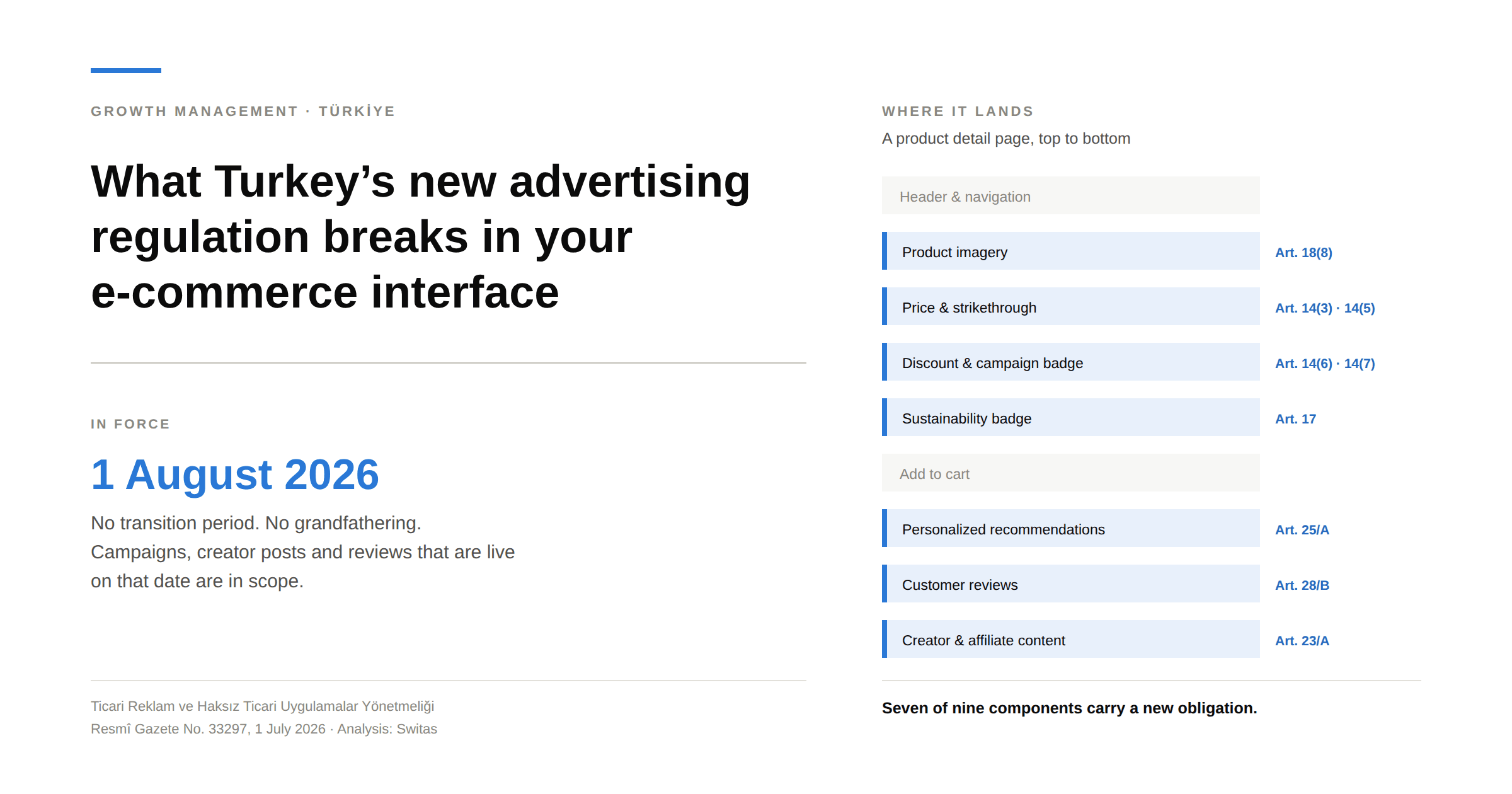
Entities Required to Comply Within 2 Years (By June 2027): - Service providers engaged in e-commerce within the scope of the Law on the Regulation of Electronic Commerce,.
3. The Technical Standard: What is WCAG 2.2?
The circular designates WCAG 2.2 as the technical standard for compliance,. WCAG 2.2 builds upon previous versions (2.0 and 2.1) and introduces specific improvements for users with cognitive disabilities, low vision, and motor impairments,.
The guidelines are structured around 4 fundamental principles (POUR):
A. Perceivable: Information and user interface components must be presentable to users in ways they can perceive (e.g., providing text alternatives for non-text content like images, ensuring sufficient color contrast),.
B. Operable: User interface components and navigation must be operable (e.g., all functionality must be available from a keyboard, users must have enough time to read and use content),.
C. Understandable: Information and the operation of the user interface must be understandable (e.g., text is readable, web pages operate in predictable ways, and input assistance is provided to avoid mistakes),.
D. Robust: Content must be robust enough that it can be interpreted reliably by a wide variety of user agents, including assistive technologies (e.g., compatible with screen readers),.
Critical Success Criteria Introduced with WCAG 2.2
To ensure full compliance, organizations must understand the specific technical nuances introduced in version 2.2. Here are the expanded details on the new key criteria:
Focus Not Obscured (Minimum & Enhanced) (Criteria 2.4.11 / 2.4.12): When a user navigates a page using a keyboard (tabbing through links and buttons), the item they are currently focused on must remain visible. This update addresses the common issue where "sticky headers" or "sticky footers" (fixed bars at the top or bottom of the screen) hide the element a user is trying to see.
Requirement: You must ensure that the focused item is not entirely hidden by other content. Ideally, it should be fully visible.
Dragging Movements (Criterion 2.5.7): Some interfaces require users to drag objects (e.g., drag-and-drop file uploads, sliders, or reordering lists). This can be physically impossible for users with motor impairments who use specialized pointing devices or eye-tracking software.
Requirement: If an interface uses dragging, you must provide a "single pointer" alternative. For example, instead of dragging a map to move it, provide up/down/left/right buttons. Instead of a drag-and-drop list, provide arrows to move items up or down.
Target Size (Minimum) (Criterion 2.5.8): Users with hand tremors, large fingers, or those using mobile devices often struggle to tap small, crowded buttons.
Requirement: Interactive targets (buttons, icons) should be at least 24x24 CSS pixels in size. If the target is smaller, there must be sufficient spacing around it so that a 24-pixel diameter circle centered on the control does not overlap with any other target. This reduces the risk of accidentally activating the wrong function,,.
Accessible Authentication (Criterion 3.3.8): Many login processes require solving puzzles (CAPTCHAs), memorizing passwords, or transcribing one-time codes sent via SMS. This creates a barrier for users with cognitive issues or memory limitations.
Requirement: Authentication processes should not rely on a "cognitive function test" (like solving a puzzle or memorizing information). You must allow copy-and-paste functionality for passwords and codes, and support the use of third-party password managers and autofill features. If a CAPTCHA is used, there must be a non-cognitive alternative (e.g., simple object recognition or 2FA via a device).
Redundant Entry (Criterion 3.3.7): Asking users to re-enter the same information (like a shipping address) multiple times in a single session causes fatigue and increases error rates, especially for users with cognitive disabilities.
Requirement: Information previously entered by the user should be either auto-populated or available for the user to select from a dropdown list, rather than requiring re-typing.
Consistent Help (Criterion 3.2.6): Users who need assistance often struggle to find support channels if they move around on different pages.
Requirement: If you provide help features (like a chat bot, contact email, or "How to" page link), they must appear in the same relative location on every page where they are present. For instance, if the chat widget is at the bottom right on the homepage, it cannot move to the top left on the product page,,.
4. Audit, Monitoring, and the "Accessibility Logo"
To manage this transition, the Ministry of Family and Social Services has established a "Monitoring Commission." Furthermore, every responsible institution must form its own internal "Accessibility Review Commission" to conduct technical analyses and report findings,.
Websites and mobile applications that pass the audit and prove compliance with the standards will be awarded the "Accessibility Logo" by the Ministry. This logo acts as a badge of honor, signifying an "accessible institution," and is valid for 2 years upon issuance,,.
5. How Switas Consultancy Supports Your Compliance Journey
Accessibility is not merely a legal checkbox; it is a critical component of User Experience (UX) and SEO performance. Switas guides you through this transformation with a structured methodology:
1. WCAG Audit (WCAG 2.2): We conduct a rigorous evaluation of your digital assets against the new WCAG 2.2 criteria, identifying specific violations regarding focus visibility, target sizes, authentication barriers, and more,.
2. Manual & User Testing: Automated tools capture only a portion of issues. Our experts perform manual audits using screen readers (like NVDA, VoiceOver) and conduct real-world tests with users who have disabilities to ensure genuine usability,.
3. Remediation Roadmap: We work directly with your development and design teams, providing technical solutions for complex code-level issues (ARIA labels, semantic HTML, responsive reflow),.
4. Sustainability & Training: Accessibility is an ongoing process. We offer periodic re-assessments and team training to ensure your digital products remain compliant as they evolve.
Contact us today to remove digital barriers and ensure full compliance with the new Turkish accessibility regulation.