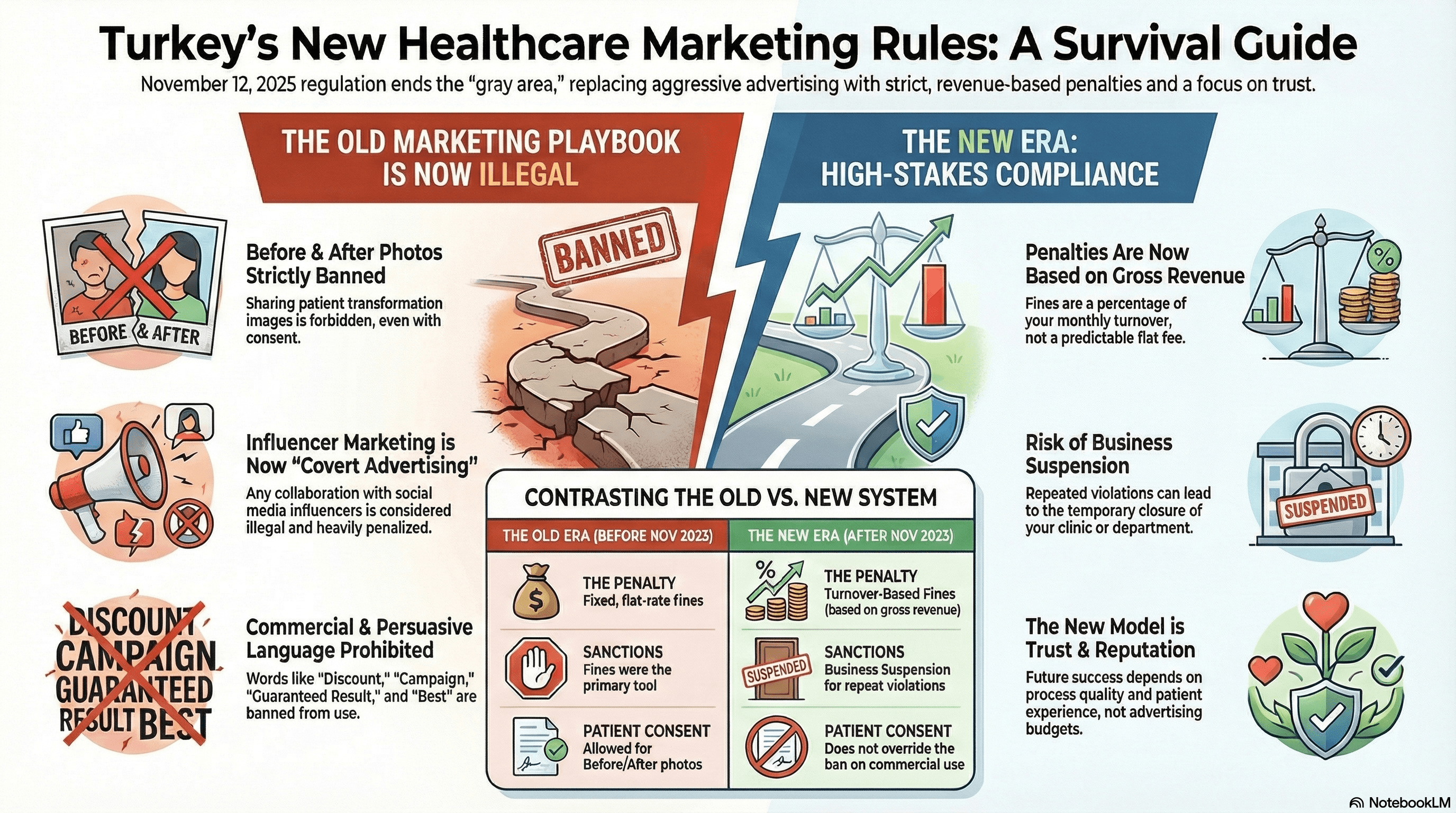
On November 12, 2025, the Turkish Ministry of Health published a landmark regulation in the Official Gazette (No. 33075), titled "Regulation on Promotion and Information Activities in Health Services."
For years, the Turkish healthcare sector—especially health tourism—operated in a "gray area" regarding marketing. This new regulation effectively paints those gray areas black and white. The message from Ankara is clear: Healthcare is not a commercial commodity, and "marketing" as we know it is over. It is now the era of "Information" and "Compliance."
At Switas, we have analyzed this seismic shift to help you navigate the new landscape. Here is everything you need to know.
1. The Red Lines: What is Now Strictly Prohibited?
The regulation aims to strip the "commercial" aspect from healthcare services. The following are now explicitly banned:
- The End of "Before & After": This is the biggest blow to aesthetic clinics. Sharing visual content that shows a patient's pre-op and post-op state to create a "success story" is strictly forbidden. Even with patient consent, these images are viewed as creating demand rather than informing.
- Influencer Marketing Ban: Collaborations with social media phenomena are now classified as "covert advertising." An influencer saying, "I went to Clinic X and loved it," is now a liability.
- Operating Room Content: Videos of surgeries, injections, or bloody procedures—often used to prove technical skill—are banned due to general morality and privacy concerns.
- No Commercial Language: Words like "Campaign," "Discount," "Free Exam," "Guaranteed Result," "Best," "First," or "State-of-the-Art" are prohibited.
- Sponsored Content Limits: "Boosting" posts to create demand is heavily restricted. The focus must be on organic information, not paid patient acquisition.
2. The "Game Changer": Why This Time is Different?
Many clinic owners might think, "These bans existed before; nothing will change." This is a dangerous misconception. The fundamental mechanics of enforcement have changed.
The Switas Takeaway: The era of "I'll pay the fine and keep running the ad" is over. A fine based on your gross turnover is not a marketing expense; it is a financial crisis.
3. Learning from Finance: The "Compliance" Shift
To understand where healthcare is going, we must look at the Banking and Finance sector. The transformation the healthcare sector is undergoing today mirrors the strict regulations introduced by the BDDK (Banking Regulation and Supervision Agency) in the past.
Just as banks cannot promise "Guaranteed 100% Returns," clinics can no longer promise "Guaranteed Results."
Parallels between Finance and Health:
- "Investment Advice" vs. "Medical Advice": Just as financial influencers must state "This is not investment advice (YTD)," doctors must ensure social media is for general education, not personal diagnosis.
- Risk Disclosures: Finance is forced to highlight risks, not just profits. Similarly, health marketing must now focus on informing patients about potential complications, not just the "perfect dream look."
- The Rise of Compliance Departments: Banks have massive internal audit teams. Healthcare organizations must now integrate legal and compliance officers into their marketing teams.
4. Global Context: Turkey is Joining the League of Ethical Standards
Turkey is not alone in this restriction. This regulation aligns Turkey with global ethical marketing standards, moving it away from a "Wild West" reputation toward a mature, regulated market.
- 🇩🇪 Germany: Under the Heilmittelwerbegesetz, "Before/After" photos for aesthetic procedures are strictly banned. Turkey has adopted this German model.
- 🇫🇷 France: Medicine is viewed as a public service, not a business. Commercial advertising is heavily restricted, allowing only basic contact and expertise information.
- 🇰🇷 South Korea: Despite being an aesthetic hub, ads often undergo "pre-screening" by medical boards to prevent misleading claims.
- 🇺🇸 USA & 🇬🇧 UK: While visual rules are looser, transparency is king. Authorities (FTC/ASA) aggressively punish undisclosed influencer ads—a standard Turkey has now codified.
5. Switas Forecast: What Does the Future Hold?
Based on our experience in regulated industries, here is what we foresee for the medium term:
A. Digital Accreditation & Platform Bans
Following BDDK rules, platforms like Google and Meta restrict unverified financial institutions from advertising.
- Prediction: Soon, you may not be able to open an ad account for a clinic on Google/Meta without uploading a valid Ministry of Health license. "Merit-based" access will replace "Payment-based" access.
B. The Rise of "Health Aggregators"
In banking, when direct product marketing became complex, Aggregator Platforms (like HangiKredi, Hesapkurdu) emerged to compare rates.
- Prediction: Since clinics cannot compete on "price" or "showy ads," independent Health Guide Platforms will rise. These platforms will list clinics based on objective data (location, specialties, verified reviews) rather than commercial claims.
C. AI-Powered Audits
There are ~30 banks in Turkey, but thousands of clinics. Manual auditing is impossible.
- Prediction: The Ministry will likely use AI tools to scan social media for prohibited keywords ("guaranteed," "discount") and image patterns (before/after splits), triggering automatic investigations.
The New Currency is "Trust"
The "aggressive marketing" era in Turkish healthcare has officially ended. The new currency is Trust, Reputation, and Patient Experience.
Comparison of marketing budgets will no longer define the winner; process quality will.
As Switas Consultancy, we are ready to assist you in:
- Auditing your digital footprint for compliance risks.
- Transitioning your strategy from "Advertising" to "Reputation Management."
- Preparing for the future of "Health Aggregators" and platform regulations.
Don't risk your revenue. Let's build a sustainable, compliant future together.