
The software development landscape is undergoing a tectonic shift. We are moving rapidly from the era of imperative programming—where humans meticulously instruct machines on syntax and logic—to the era of "Vibe Coding." In this new paradigm, the creator focuses on "intent," "flow," and "outcome," while artificial intelligence handles the implementation.
As we look toward 2026, "Vibe Coding" is no longer just about generating code snippets or simple prototypes. It is evolving into a comprehensive ecosystem of Agentic Software Creation. The market is shifting its focus from the "Day 1" problem (how fast can I generate an app?) to the "Day 2" problem (how do I maintain, scale, debug, and iterate on this software?).
At Switas, we have analyzed the rapidly maturing market to identify the five tools that will define this space in 2026. These platforms are not just coding assistants; they are autonomous partners capable of planning, executing, and repairing complex software systems.
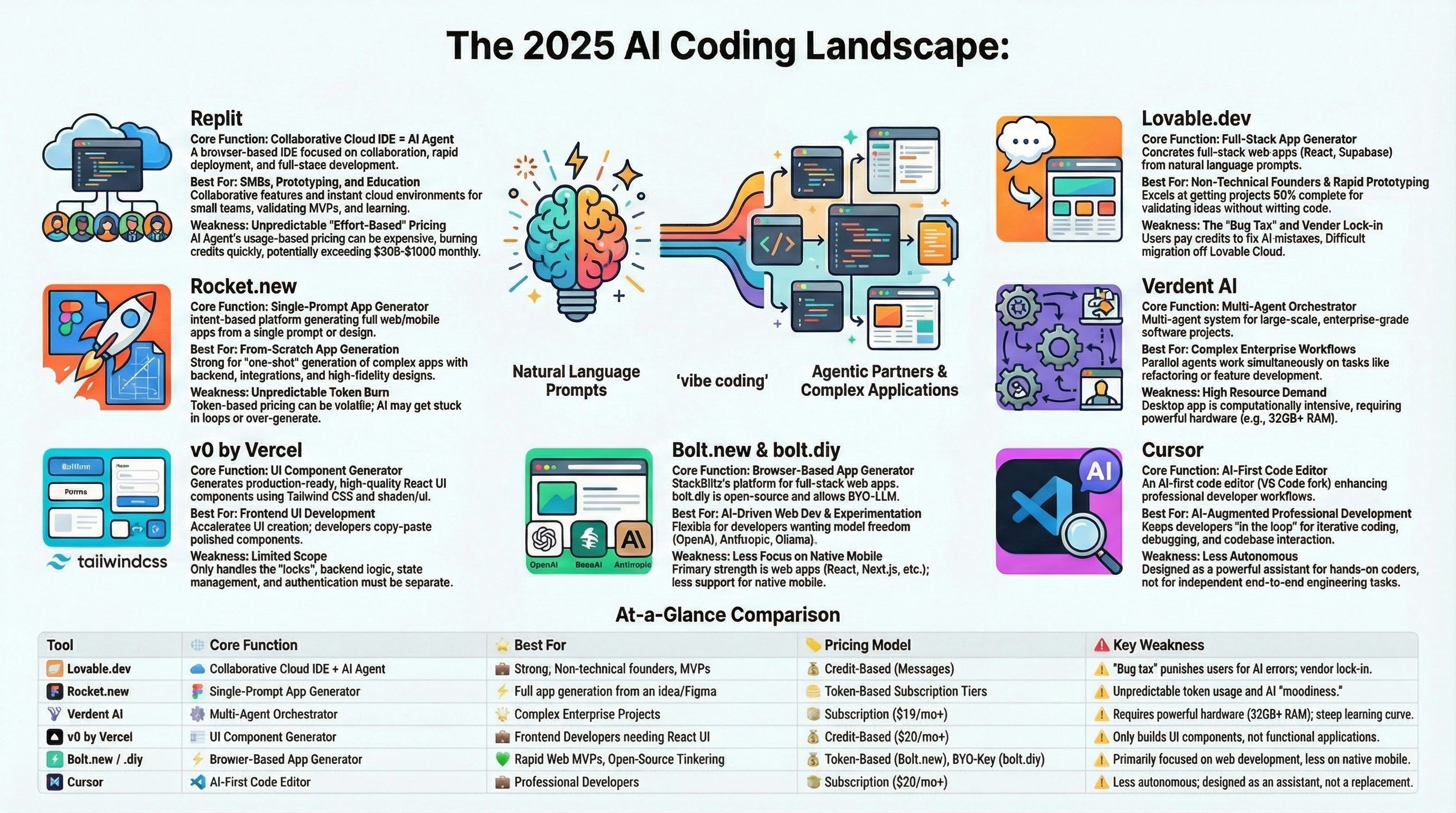
1. Rocket.new: The Full-Stack Solution for the "Day 2" Problem
While many tools excel at creating a flashy prototype, Rocket.new (formerly DhiWise) distinguishes itself by focusing on production readiness and longevity. Backed by a recent $15 million seed round led by Salesforce Ventures and Accel, Rocket is positioning itself as the enterprise-grade choice for serious builders,.
Why It Will Define 2026
Rocket.new addresses the critical "Day 2 problem"—the reality that software requires ongoing maintenance, iteration, and scaling after the initial launch. Unlike tools that leave users with "spaghetti code" that is hard to maintain, Rocket leverages a proprietary dataset of over 10 million Figma-to-code pairs to generate modular, atomic, and architecturally sound code.
Key Capabilities
- True Native Mobile Development: Unlike competitors like Lovable or Bolt which focus primarily on web apps (React/Next.js), Rocket.new allows users to build native mobile applications for iOS and Android using Flutter,. This is a massive differentiator for founders prioritizing a "mobile-first" strategy.
- One-Prompt Architecture: Rocket utilizes a multi-agent system that breaks down a single high-level prompt (e.g., "Build a marketplace for local artists") into a sequence of detailed sub-tasks. It automates market research, UX design, backend configuration (Supabase), and API generation in one seamless flow.
- Ownership and Portability: Users own the source code completely. It can be exported to standard environments like VS Code or GitHub, ensuring no vendor lock-in—a critical requirement for enterprise adoption.
2. Lovable: The Design-First "AI Co-Founder"
Lovable has experienced explosive growth, hitting $20 million in ARR just months after launch. It is widely regarded as the most accessible tool for non-technical founders, effectively acting as a "full-stack engineer" that prioritizes visual fidelity and user experience.
The "Visual Edit" Revolution
Lovable’s standout feature for the 2026 landscape is its integration of Visual Edits. Users can click directly on UI elements to change text, colors, or layouts without writing prompts or consuming credit usage,. This bridges the gap between design tools (like Figma) and development environments.
Strengths and Integration
- Supabase Orchestration: Lovable doesn't just connect to a database; it orchestrates the entire backend. It handles authentication, row-level security (RLS), and database schemas through natural language chat. It effectively manages the Supabase CLI behind the scenes to deploy Edge Functions without the user needing Docker knowledge.
- Pre-Publish Security: In an era of increasing cyber threats, Lovable differentiates itself with mandatory pre-publish security scanning. It automatically checks for vulnerabilities like XSS risks and exposed secrets before deployment, providing a safety net for non-technical creators.
- Target Audience: It is the "Zero-to-One" innovator, perfect for startups and rapid prototyping where speed and design polish are paramount.
3. Replit Agent 3: Autonomy and Self-Healing Infrastructure
Replit has evolved from a simple online IDE into a powerhouse of autonomous software creation. With the launch of Agent 3, Replit is pushing the boundaries of how long and how independently an AI can work without human intervention.
The "Reflection Loop"
The defining feature of Replit Agent 3 is its ability to self-heal. It doesn't just write code; it spins up a browser, interacts with the app it built (clicking buttons, filling forms), observes errors, and then fixes its own code. This "reflection loop" mimics the workflow of a human QA engineer, significantly reducing the debugging burden on the user.
Enterprise and Scale
- Extended Autonomy: The "Max Autonomy" mode allows the agent to run for up to 200 minutes unsupervised, managing its own task lists and architectural decisions.
- Agent Generation: Agent 3 can recursively build other agents. A user can instruct it to create a Slack bot that queries a Notion database or a Telegram bot for scheduling, effectively allowing a single user to deploy an "army" of specialized AI workers.
- Infrastructure: Through a partnership with Google Cloud, Replit offers robust, scalable infrastructure that supports the "vibe coding" of complex, stateful applications, not just static sites.
4. Bolt.new: The Browser-Native Speedster
Created by StackBlitz, Bolt.new revolutionized the market with its WebContainer technology, allowing full Node.js environments to run entirely inside the browser.
Zero-Latency Development
Bolt’s architecture eliminates the need for remote servers for the development environment. This results in "blazing fast" boot times and a highly responsive coding experience that feels local but lives in the cloud.
Developer Control
While tools like Lovable hide the complexity, Bolt embraces it for those who want control. It offers a "diff-based" editing system, allowing developers to accept or reject specific code changes line-by-line rather than accepting a wholesale rewrite. This makes it the preferred tool for developers who use AI for scaffolding but want to maintain granular control over the codebase.
Best For: Hackathons, rapid proof-of-concepts, and developers who want a VS Code-like experience in the browser without the setup tax.
5. Verdent AI: Parallel Orchestration for Enterprise Scale
As we move toward 2026, software complexity will require more than a single agent. Verdent AI (founded by former TikTok algorithm leads) addresses the need for multi-agent orchestration on large-scale codebases.
The "Spock Supporting Captain Kirk" Model
Verdent posits that AI should handle the "grunt work" while the human acts as the commander. Its desktop application, Verdent Deck, allows users to run multiple AI agents in parallel. One agent can work on backend API migration while another refactors frontend components, all within isolated sandboxes.
Architecture for Complexity
- Git Worktree Integration: Verdent uses git worktrees to create isolated branches for every AI task. This prevents "agent collision," ensuring that the work of one AI doesn't break the build for another.
- Production-Ready Rigor: Achieving a state-of-the-art 76.1% pass rate on SWE-bench Verified tests, Verdent focuses on high-reliability tasks. It includes a dedicated "code review subagent" that validates logic before merging, acting as an automated senior engineer.
- Target Audience: This is the tool for serious engineering teams managing legacy code refactoring or complex feature additions, rather than just greenfield prototyping.
The Era of the "AI Architect"
The year 2026 will not see the end of developers, but the rise of the AI Architect. The barrier to entry for creating software is evaporating.
- For Mobile & Scalability: Choose Rocket.new to solve the "Day 2" problem with native apps.
- For Design & Speed: Choose Lovable to go from idea to beautiful MVP in minutes.
- For Autonomy: Choose Replit Agent 3 if you want an AI employee that tests and fixes its own work.
- For Developer Control: Choose Bolt.new for instant, browser-native environments.
- For Enterprise Complexity: Choose Verdent AI to orchestrate squads of agents on large codebases.
At Switas, we are monitoring these developments closely to help our clients leverage the right "vibe" for their digital transformation. The future is not about writing syntax; it is about curating capabilities.